Coronavirus Outbreak Results in Quarantine of Alabama Pastor and Church Members in Israel

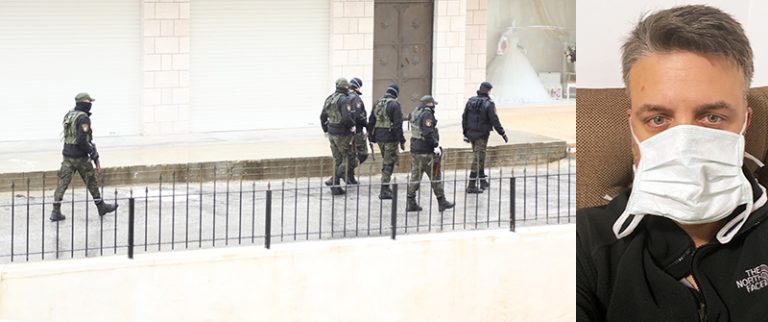
BETHLEHEM, Israel (BP) — A Southern Baptist pastor on lockdown in a Bethlehem area hotel while awaiting results of testing for the coronavirus (COVID-19) said he and his 12 congregants are confident God will use the experience for His glory.

Pastor Chris Bell and 12 members of 3Circle Church based in Fairhope, Ala., were tested with nose swabs for COVID-19 Friday (March 6) and expect results within a day, he told Baptist Press. They have been quarantined since Thursday at the Angel Hotel in Beit Jala after a hotel resident tested positive for the virus.

“It is impossible for me to believe that God does not have a plan for this,” Bell told BP, “because how in the world could we end up in the hotel where the epicenter of this thing takes place?

“And we are convinced — we don’t like it, we don’t want it — but we’re convinced God’s going to use this. We’re convinced that He knows exactly where we are, and He has not forgotten us. And we believe that deeply.”

When Bell, church leaders and their wives traveled to Israel for a tour of the Holy Land, they were assured Israel was one of the safest places to travel while avoiding the coronavirus outbreak, he said. What were only three cases in Israel when the group left the U.S., he said, have since grown to at least 21, Israel’s health ministry announced Friday.

Despite faith, Bell and his members are still suffering.

“But of course we’re human,” he said, “and we’re worried and concerned and tired and exhausted and all of those things. Our emotions are running the gamut for sure.”

Southern Baptist Convention Executive Committee President Ronnie Floyd contacted White House and U.S. State Department officials Friday to ensure they are aware of Bell’s situation, Floyd told BP.

Bell pastors the multisite 3Circle Church in Alabama, with campuses in Fairhope, Mobile and Daphne. The travelers have no indication of what the Israeli government’s procedure will be when tests results are received, but are eager to return home.

Source: Baptist Press

All Content & Images are provided by the acknowledged source

Nashville Worship Team’s Album Features Verbatim Scripture

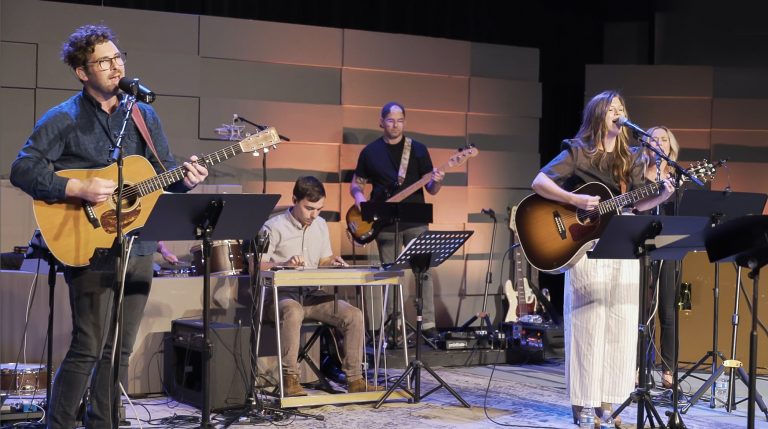
NASHVILLE (BP) — Fulfilling a goal to produce an entire album of songs using verbatim Scripture, the Immanuel Nashville worship team recently released their second album titled “Romans 8 — Live.”

The 15-track record features songs alternating with Scripture readings from Romans 8 by artist Shai Linne and sermon excerpts from pastors Ray Ortlund, T.J. Tims and Sam Allberry.

All of the songs feature portions of Romans 8 exactly as they are written in the English Standard Version, a feat not easily accomplished in the songwriting world.

“Conceptually this seems to be something that had really never been done before, in terms of including the sermon pieces and the Scripture and the music,” Jessica Waterman, musical director at Immanuel, said.

The songs from Romans 8 were not intended to turn into a full-length album, Waterman explained.

Beginning ideas

The church was going through a sermon series focused on Romans 8 and Waterman simply set out to write some songs that helped the congregation internalize the truths.

“What can we do as the worship ministry to come alongside what he’s [Pastor Ortlund] doing?” Waterman said she asked herself and the team.

Waterman knew that personally, music helps her with memorization of Scripture.

Songs help get Scripture into believers’ hearts, she said.

The first two tracks of the album, “No Condemnation” and “If Christ Is in You” were birthed out of her own personal mediation on the Scripture, trying to see what melodies God would bring to her mind, Waterman explained.

Co-writing played a large part in album with the tracks “Who Shall Separate Us”, “Abba Father” and “Sons of God,” but Waterman said she was personally encouraged by the solo writing she was able to do for the album.

“Sometimes I bring insecurity to those moments when I try to write by myself,” Waterman said. “Can I do this on my own? Do I need somebody to come alongside me and write this?”

The joining of creative minds is awesome, Waterman said, but having the encouragement from the Lord with her individual part in the album’s songs was a blessing.

The goal with many of the songs on the album, in addition to utilizing verbatim Scripture, was to create singable melodies for the congregation, Waterman noted.

Waterman said as she wrote she asked herself “How can we hear this one time and still be able to sing it with each other? How can we dwell on the Scripture with music?”

The challenge of style

Although writing verbatim Scripture was a new challenge, it was a rewarding experience to see how the crafted melodies folded around the words that otherwise may have been altered or changed, Waterman said.

“Sometimes, as songwriters, we can shy away from doing this kind of thing because it seems like too daunting of a task,” Waterman noted. “But what I loved about it was that we came at it like we’re not trying to make this into our own thing, we’re trying to take what God has given through His Word and create melodies that can go along with that.”

The album ranges stylistically all the way from folk and country influences featuring prominent fiddle lead lines and steel guitar droning slides to heavy rock grooves with soaring electric guitar riffs.

Waterman said the inclusion of diverse styles was very purposeful in the arrangement of the songs as well as the actual writing process.

“There’s so many different ways that we can come to the Scripture and there’s so many different ways we can sing it. The Lord is not limited by style, and He’s not limited by melodies,” Waterman said. “He’s still exalted through however we choose to sing and lift His Scripture.”

The team wanted to create an album of various styles in order to keep it exciting, fun and prevent the wearing out of one particular musical feel, Waterman said.

“We try to not be tied to one style or one arrangement of a song but we really try to touch on a lot of different kinds of music,” Waterman noted. “We’re commanded to sing; we’re not commanded to play a certain style or with certain instrumentation.”

The album reflects to a great degree what the weekly services look like at Immanuel Nashville.

With instrumentation including banjos, trumpets, saxophones and pedal steel alongside drums, piano, guitar and bass, Waterman said no music style is off limits for the team.

“Nothing’s off the table in terms of musical style and diversity, and we know we still have a long way to go with that,” Waterman said.

T.J. Tims, lead pastor at Immanuel, said the album in its usage of singing, preaching and spoken word all together, showed the diversity in which God is worshiped.

“The line between preaching, singing, spoken word, are very arbitrary, and when we sing, we’re preaching,” Tims said. “There’s a very real sense in which God preaches and sings the world into existence.

“Each one brings its own element, of course,” Tims continued. “But they’re all essentially doing the same thing, and it’s proclamation, it’s preaching the Word of God.”

Source: Baptist Press

All Content & Images are provided by the acknowledged source

Tennessee Pastor Says God Used His Dog’s Barking to Save His Family From Tornadoes

COOKEVILLE, Tenn. (BP) — For the first time in his life, Darrin Crockett is glad God did not answer his prayer.

On Monday night, March 2, Crockett and his family went to bed as always. Their dog Doc, however, barked incessantly throughout the night. Crockett remembers asking God “to make that dog quit barking.”

God apparently chose not to answer that prayer. As a result, the Crockett family is alive and well after an estimated EF-4 tornado blasted through their home in Cookeville, Tenn., leaving them trapped under a pile of rubble.

Reflecting on that night, Crockett sees how God orchestrated their survival. Had Doc not barked most of the night, Crockett may not have heard his phone alarm signaling a storm warning. As a result of the warning, he, his wife Jenny and daughters Carly, Camryn and Carrigan took refuge in the laundry room, the only place they probably could have survived, Crockett said.

“We heard it coming and suddenly the house began to shake,” he said. “Next thing I remember is I felt grass underneath me. The tornado must have picked up the entire house, dropped it in the yard with us buried underneath it.”

A two-by-four that fell across an overturned washer and dryer likely provided enough room to keep them from being crushed. When the storm passed, lighting flashes exposed what few openings there were, and the family crawled out from the collapsed building with only a few minor cuts and scratches.

Crockett, associate pastor of VineBranch Community Church and a school administrator and athletic director at Highland Rim Academy, both in Cookeville, acknowledged that their survival is a miracle.

“It is amazing,” he said. “If our dog had not alerted us, who knows where we would have ended up?”

As he stood near the pile of rubble that once was his house and watched volunteers salvage items and drag the ruins to nearby trash piles, Crockett knew without a doubt that God spared him and his family.

Source: Baptist Press

All Content & Images are provided by the acknowledged source

Pastor Paul Kim on What You Should Be Waiting for

Paul Kim is pastor emeritus of Antioch Baptist Church in Cambridge, Mass. The views expressed in this commentary are solely those of the author(s) and do not necessarily represent those of BCNN1.

CAMBRIDGE, Mass. (BP) — At his father’s deathbed, Bob Sparks made a promise to his father that he would find the remains of his father’s dear brother, Army Corporal Ron Sparks, who died in a POW camp in North Korea during the Korean War. The good news came one day when the DNA sample he had given came back from an army lab with a 100 percent match.

On August 16, 2016, a military procession brought the remains of Corporal Ronald Sparks to Cambridge (Mass.) City Hall. Family, friends, veterans, local government officials, fire fighters, police officers, a sizable contingent of the Korean community, and a throng of patriotic supporters had gathered to honor the memory of the city’s native son and long-lost fallen soldier.

It came to be a significant event, with the local media giving it wide coverage. The mayor of Cambridge spoke poignantly of how Sparks, who had sacrificed his life for our freedom, was finally home. The Korean Consul General of Boston presented the Ambassador of Peace Medal to Sparks’ sister. As a clergyman and national assistant chaplain of the Korean War Veterans Association, I was privileged with the opportunity to offer my remarks of gratitude. The next day Cpl. Sparks was given a full military funeral and was laid to rest next to his parents, who never got to see their son after sending him off to war. The surviving family members had waited 65 long years for this unforgettable moment.

Waiting is a way of life. In our day-to-day existence we wait for so many things. In Samuel Beckett’s well-known existential play “Waiting for Godot,” two characters wait for the mysterious Godot, who never shows up. The play makes us ask ourselves, what are we waiting for in this life? Are you waiting for graduation, career, marriage, house, children, retirement, etc.?

All these things will eventually fade away. Doesn’t it make sense then to wait for something that is eternal? At the return of the Lord Jesus, He will take His church, the family of God, to be with Him in a loving relationship forever. Since our Lord and His angels promised that this will happen, it is worth waiting in faith for its fulfillment.

Source: Baptist Press

All Content & Images are provided by the acknowledged source
Mike Glenn on a Pastor With a Capacity Problem

Mike Glenn is Senior Pastor at Brentwood Baptist Church. The views expressed in this commentary are solely those of the author(s) and do not necessarily represent those of BCNN1.

One day, a young pastor reached out to me to talk about his church. I’ve found out if you stay at one place for long enough, people begin to think that you’re an expert of some sort. I’ve been at Brentwood Baptist Church for 28 years, and well, people think I actually know what I’m doing.

So, he had a church growth question. “Our church has grown to about 1,000 on Sunday morning, but we can’t seem to grow past that. We’ll bump up to 1,100 or 1,200 and then, we’ll drop back to 900 and start over again. What do you think?”

“You have a capacity problem,” I said.

“No,” he answered, “we have plenty of space in our buildings.”

“You didn’t hear me,” I said. “I didn’t say you didn’t have any space in your buildings. I said you, the pastor, have a capacity problem”.

I went on to explain that what he was finding out again and again was the limits of his own capacity as a leader. He could, in his current practices and systems, handle about thousand people, but he lacked the capacity to handle more. If his church was going to grow, he would have to create more capacity as the pastor of his church.

When you’re in your first pastorate, you do everything. You take care of the budget, the printing, maintenance, community relations and pastoral care. You preach all of the sermons, do all of the weddings and funerals, and you pray all of the prayers. While you’re in the middle of it, you’re constantly overwhelmed and under prepared. In the long run, however, it does prepare pastors for the long many facets of ministry.

The irony of the ministry is the larger your church, the fewer things you do. My church needs to be doing a handful of things – and only a handful of things. They don’t need me to do anything else. In fact, I actually hurt the church if I’m involved in areas where I don’t have any passion or gifting. There are people in my church who are much better than I am in any number of things.

Basically, my church needs me to do two things: study to preach and teach the Scriptures and think about the future of our church. So, over the years, my job has come down to three things: preaching and teaching, training leaders and vision. That’s it. A very effective team of staff and lay leaders handle everything else.

I say “over the years” because with me being at this church for 28 years, I’ve actually been the pastor of 4 or 5 churches at the same address. We’ve gone from a community-based church from a regional congregation to a multi-site congregation. Each time, we had to rethink the role of the pastor. What does the church need from me at this stage of the church’s life? How involved do I need to be in the various processes of congregational life? What can I release to a lay person? When do we need to hire a person of particular skills to better define our church’s structure?

Source: Christianity Today

All Content & Images are provided by the acknowledged source
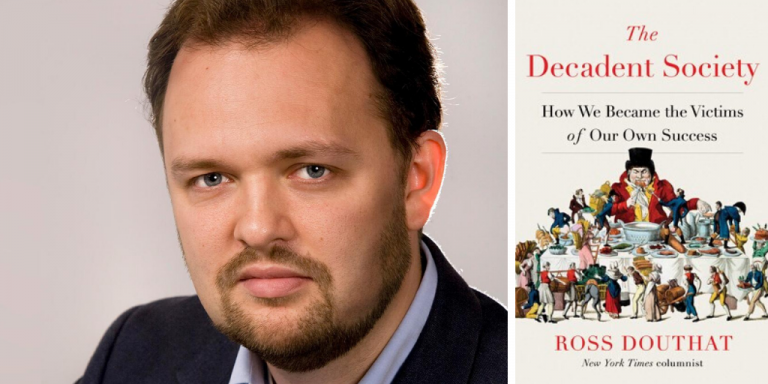
David Moore Interviews Ross Douthat on New Book ‘The Decadent Society: How We Became the Victims of Our Own Success’

Interview with Ross Douthat, The Decadent Society

Ross Douthat is a writer for the op-ed section of The New York Times.

The following interview revolves around Douthat’s much anticipated book, The Decadent Society: How We Became the Victims of Our Own Success.

Moore: I’ve read your two previous books, To Change the Church and Bad Religion. It seems that you take up your pen to write regularly on decline and drift. To what degree, if any, does this present book extend and build on the concerns of the previous two books?

Douthat: As the titles suggest, those were both books about religion, about American and Catholic Christianity, and about the ongoing theological civil wars that have hobbled institutional religion in the Western world since the 1960s. So you could say they were about decadence, in a certain way – about a period of theological stalemate and institutional decay. And The Decadent Society, then, widens the lens to capture secular society as well, and tries to figure out why exactly the future hasn’t ended up being as dynamic and hopeful and creative as many people in the 1960s expected them to be.

Moore: The word “decadent” conjures up all kinds of images depending on your frame of reference. What exactly do you mean by decadent?

Douthat: Not exactly what most people might expect: This isn’t a book about moral decline, or at least it isn’t only about that. Rather, I’m using decadence to describe a situation that rich societies enter into once they stop advancing, stop having new frontiers to explore, stop having pride in their own past and confidence in their future. A decadent society is characterized by stagnation, drift and repetition at a high level of development – by political stalemates that nobody can figure out how to break, by disappointing economic growth and slowing technological progress, by declining birthrates and old age, and by cultural repetition as people return to the same fashions, movie franchises and ideological arguments. For us, that means an eternal return to 1975 or so, an endless recycling of Baby Boomer arguments and stories and ideas.

Moore: You take pains to show that the past thirty years don’t have the impressive breakthroughs in technology as the thirty years before those. How can that be with I-Phones, the Internet, and self-driving cars?

Douthat: You mean the self-driving cars that can’t drive in rain or snow and seem likely to be “just years away” for years to come? But that riposte aside, the internet is clearly a tremendous breakthrough, and the great exception to the story of stagnation, and the least decadent area of our economy. However, that concession comes with two caveats: First, our internet-era innovations are narrower than in past eras of American history, concentrated in technologies of communication and simulation and less substantial in areas like energy and transportation and even medicine (where we’ve made grinding progress but few penicillin-level breakthroughs). Second, the nature of that innovation, the way it encourages people to retreat into virtual worlds or disappear into their screens, has the effect of accentuating decadence in other areas – directing political impulses away from real-world organizing and into “likes” and “faves,” drawing young people away from marriage and romance and even sex itself with the lure of virtual alternatives, creating a kind of learned helplessness about the non-online world

So yes, the internet is the exception – but one that sometimes seems to confirm the rule.

Moore: You argue, persuasively in my estimation, that there is stagnation not only in the technological sector, but in culture, media, even politics. For the last in that trifecta, aren’t Bernie and Trump novel disruptions?

Douthat: Absolutely: They represent, in different ways, rebellions against decadence — attempts to break out of the existing stalemate, forge a realignment, and push American politics onto a very different track. And it’s not a coincidence that they’re led by old men, because they’re both reaching back to the America of their youth, to the pre-decadent society if you will, with their promise to make the country great again or put it back on the path to the socialist utopia.

But as we’ve seen from Trump’s presidency, with its mix of incompetence, chaos and conventional G.O.P. policymaking, just because you want to rebel against decadence doesn’t mean you’ll win. The underlying gridlock has a way of reasserting itself, and I suspect it would do so in a Sanders presidency as well. So even though you can usefully think of Joe Biden as representing a politics of sustainable decadence, and Sanders as representing a more radical alternative, the systemic elements of decadence mean that it terms of actual policymaking their presidencies might not be that different from one another.

Source: Christianity Today

All Content & Images are provided by the acknowledged source

Han-Luen Kantzer Komline on What Early Christian Ascetics Teach Us About the Strange Hope of Lent

Han-luen Kantzer Komline is an assistant professor of church history and theology at Western Theological Seminary. The views expressed in this commentary are solely those of the author(s) and do not necessarily represent those of BCNN1.

Once upon a time in Egypt, likely sometime during the fourth or fifth century, some Christian monks were eating dates together. One of the brothers was ill and had a coughing fit that brought up phlegm. Some of it accidentally fell on another brother. The unlucky recipient’s initial impulse was to cry out in indignation, “Stop! Don’t spit on me!”

The Sayings of the Desert Fathers tells us what happened next: “To tame himself and restrain his own angry thought, he picked up what had been spat and put it in his mouth and swallowed it. Then he began to say to himself, ‘If you say to your brother what will sadden him, you will have to eat what nauseates you.’”

Even in this Lenten season, when many Christians put ashes on their heads, this behavior seems extreme. Isn’t it masochistic? How is anyone served by such a disgusting act of repentance and devotion? Other early Christian ascetics, too, were known for unusual feats. Simeon the Stylite sat atop a pillar for over 30 years. Others ate nothing but grass, confined themselves in tiny cells, lived among animals, or deprived themselves of food and other bodily necessities for extraordinary periods of time. In their own day as well as now, people have rightly questioned the purpose and spiritual value of these bizarre behaviors.

To us, suffering in general seems about as attractive as eating phlegm. We’ll do nearly anything to avoid it. But the monk in the original story has a different mindset: He’s more concerned with avoiding sin than avoiding suffering. Hating sin goes right alongside his willingness to suffer physical discomfort. “If a monk hates two things, he can be free of this world,” writes another monk. “A brother inquired, ‘What are they?’ He said, ‘Bodily comfort and conceit.’”

These quirky early Christians were not making an argument about the causes of suffering. Their point was not that every instance of suffering could be traced to a specific act of sin in the sufferer. Job and the explicit teachings of Jesus (John 9:3) would have ruled that logic out. Instead, they were acknowledging the fact that sin breeds suffering as surely as murder leads to death (Romans 6:23). It hurts the sinner, and its effects ripple outward to impact untold others as well.

Perhaps appropriately, then, the way to healing from sin often leads through suffering, not around it. We follow Christ by taking up our crosses, not by averting our eyes, hands, and hearts from the pain of Golgotha.

The message of the ascetics is simple: Lament your sin, even though it hurts.

For these “new martyrs,” as they were often called, lamenting sin was not just an abstract ideal. It was a concrete command of God that took skill, diligence, and divine assistance to obey. Their starting assumption was that repentance should be the continual pattern of the Christian life, not an unusual aberration. In the words of one hermit, “As the shadow goes everywhere with the body, so we ought to carry penitence and weeping with us everywhere we go.”

Of course, there’s more to the Christian journey than sorrow and tears. But if we want to make progress, we’ll need to keep these with us—at least until this life is over. No one is exempt from repentance. As another hermit put it, “When God struck Egypt there was not a house that did not mourn.” By that he means that sin and its effects are universal. We cannot delude ourselves by thinking that we stand squarely on the side of the victims. We are the Egyptians, every last one of us. The logs in our own eyes should be our first concern. Or in the words of yet another ancient Christian ascetic, “Always look at your own sins, and do not judge another’s.”

Source: Christianity Today

All Content & Images are provided by the acknowledged source
Timothy Willard on Why I Gave Up Fasting for Lent

Timothy Willard (PhD, King’s College London) is a writer, podcaster, and independent scholar based in Charlotte, North Carolina, where he lives with his wife, three daughters, and a band of rowdy Great Horned Owls. He is the author of three books and the rider of mountain trails. The views expressed in this commentary are solely those of the author(s) and do not necessarily represent those of BCNN1.

Does giving up espresso bring me closer to God? This thought burned through my mind as I sat and listened to the boys’ choir sing Psalm 37 during Evensong at Christ Church Cathedral in Oxford, England, a few years ago. With Ash Wednesday a mere two days prior, it seemed like everyone was giving up lattes and social media and the internet and announcing it to the world. One friend defended fasting from these activities because of how they intrude on our daily lives. I agreed. I, too, could use a break from the digital world.

But what happens after Lent and Easter Sunday, I thought to myself. Business as usual? Fire up the espresso machines? Tweet that I’m back from my social media fast?

Though I respected the beauty and depth represented in the tradition of Lent, tension grew in me. I struggled to align the good and holy intent of Lenten fasts with the very public spectacle it has evolved into for Western Christianity. We announce our screen time fasts or “disfigure our faces” when asked why we won’t have a glass of wine. Jesus exhorts his disciples to keep fasting a secret matter—an unseen act of worship to the God who is unseen (Matt. 6:16–18).

I loved how the season leading up to Resurrection Sunday swelled into what J. R. R. Tolkien called the eucatastrophe or the joyous upturn in the story of the human race. But I also observed how the pageantry fades. I loved the idea of abstaining from vices and stepping into Christ’s suffering. But I thought the spiritual discipline of fasting was meant to be more than a seasonal practice to abstain from first-world luxuries.

It was then I began a personal quest to seek out the heart of Lent.

Historically, some of the first indications of a seasonal fast appear to be even earlier than the Council of Nicea (c. A.D. 325) in practices like fasting before baptism and Easter, which only lasted a few days. But some church scholars now believe that the Lenten 40-day fast dates to a later time in the history of the church. Nicholas Russo, advising dean at the College of Arts and Humanities at the University of Notre Dame, suggests the fixed 40-day fast emerged after the Council of Nicaea, and that the early history of Lent is something of a “choose your own adventure,” and an “amalgamation of several early fasting customs and typologies.”

We may not know the direct origins of the present-day Lenten fast, but we do know the significance of the discipline. The Lenten 40-day fast pays homage to the iconic fasts found in Scripture—from Moses on Mount Sinai (Ex. 34:28) to Jesus’ wilderness fast (Luke 4:1–13). The Scriptures brim with other examples of fasting: Elijah, Ezra, Nehemiah, David, Esther, John the Baptist, and Paul, among many others.

We’re not wrong to follow suit. St. Augustine exhorted Christians to overcome “the temptations of this age, the crafty traps of the devil, the toils of the world, the allurements of the flesh, the swirl of turbulent times, and all bodily and spiritual adversity,” with fasting. We should use the nails of abstinence to hammer our lusts to the cross, he says.

But at the same time, he warned Christians not to make fasting a pretense by using Lent as a time to simply revise their pleasures, substituting one vice for a different one. “You must certainly beware of just revising, not reducing, your pleasures,” wrote Augustine in Sermon 207. “You can see some people searching out unusual liquors as a substitute for the usual wine. … The result is that the observance of Lent means, not the repression of old lusts, but the occasion for new enjoyments.”

We fast, according to Augustine, so that inordinate affections do not control us. When we fast, “the delights of the flesh are to be held in check. Esau wasn’t rejected over Weiner schnitzel or pâté de foie gras but an inordinate longing for lentils.”

Rowan Williams, master of Magdalene College at the University of Cambridge, said, “The self-denial involved in the period of Lent isn’t about just giving up chocolates or beer; it’s about trying to give up a certain set of pictures of God which are burned into our own selfish wants.”

Williams reminds us of the Pevensie children in C. S. Lewis’s The Lion, The Witch, and The Wardrobe when they first heard Mr. Beaver mention that Aslan was a lion. The children could not conceive of a lion that was both wild and good. Aslan represents something wholly other to the children. Our self-made notions of God quite often need to be (re)awakened to the God that is. We want a God who is safe, one made in our image. A self-centered approach to fasting echoes this sentiment.

The Israelites discovered this the hard way. In Isaiah 58, the premier biblical text for fasting, we find the Israelites confused. They fasted in hopes that God would draw near to them. But their empty religious expressions nauseated God. They fasted but treated others poorly. Their actions did not match their hearts.

“We humbled ourselves,” they complained. But God does not desire a show of humility. I’m reminded of Pascal’s words: “It is better not to fast, and be thereby humbled, than to fast and be self-satisfied therewith.” God desires a fasting in which we turn our hearts toward him and seek to love our neighbor.

In his book Fasting, Scot McKnight warns that evangelical Christianity can often treat fasting as something we do to get a result—like the Israelites in Isaiah 58. Need wisdom for a big decision? Fast. Need to reach your financial goal for that new youth wing? Fast. Need to break the cycle of checking your Instagram feed? Fast.

The Scriptures, however, show fasting used as both a pathway for spiritual breakthroughs (Joel 2:12) and as a response to a grievous sacred moment (2 Sam. 12:16–23). The central focus of fasting remains to draw near to God. It reveals sins from which we must repent. Fasting is an act of worship that changes our spiritual and physical posture toward God.

Source: Christianity Today

All Content & Images are provided by the acknowledged source
Scot McKnight on War Brides, War Rape, and Genocide Texts in the Bible

Scot McKnight is an American New Testament scholar, historian of early Christianity, theologian, and author who has written widely on the historical Jesus, early Christianity and Christian living. He is currently Professor of New Testament at Northern Baptist Theological Seminary in Lombard, IL. The views expressed in this commentary are solely those of the author(s) and do not necessarily represent those of BCNN1.

Some of our readers are simply unbothered by some Old Testament texts while some of our readers are undone by them, and two particularly notable themes are the war-bride or war-rape texts and the genocide, or total-kill, texts.

In William Webb and Gordon Oeste’s new book, Bloody, Brutal, and Barbaric, we encounter a forceful argument that presses against traditional ways of minimizing war bride/rape texts while holding more firmly onto genocide texts.

The argument works like this: since war bride/rape texts are given in a permission framework and genocide texts as imperatives, the latter are permanent and revelatory of God’s normative will while the former are more accommodated and therefore not so revelatory.

It is the presence of command vs. permission that separates the two. Therefore, war-bridge and war-rape texts are minimized.

The authors defeat this contention. They defeat it, in my view, decisively.

They consider that the war-rape instructions in the Bible exemplify God’s accommodated ethic (affected by a fallen world, involving real ethical problems) whereas the total-kill instructions exemplify his unaccommodated ethic (pure and pristine, involving only perceived ethical problems).

Our realigned-traditional position will argue that the war-rape and total-kill texts, while obviously describing different human acts, both reflect God’s accommodated ethic as he communicates within a fallen world.

So here are two fundamental texts for these two themes, war bride/rape here and then after this text the one on genocide or total-kill. Now, Deut 21:10-11

When you go out to war against your enemies, and the LORD your God hands them over to you and you take them captive, suppose you see among the captives a beautiful woman whom you desire and want to marry…

It is the italics (suppose you see, or “if”) that diminishes the connection to God. It is accommodation to the way things were back in those days, so it is claimed.

But the genocide texts are not “suppose” or “if” but “Do this!”

Deut 20:16-17

But as for the towns of these peoples that the LORD your God is giving you as an inheritance, you must not let anything that breathes remain alive. You shall annihilate them—the Hittites and the Amorites, the Canaanites and the Perizzites, the Hivites and the Jebusites—just as the LORD your God has commanded…

So, a distinction is drawn between permission and command.

All Content & Images are provided by the acknowledged source
Surgeon General Jerome Adams’ Advice for Churches in the Midst of the Coronavirus

Ed Stetzer is executive director of the Billy Graham Center, serves as a dean at Wheaton College, and publishes church leadership resources through Mission Group. The Exchange team helped with this article.

Don’t panic… Stop buying masks… Wash your hands.

And, stop shaking hands in church.

All of those were part of a conversation this morning with Surgeon General Jerome Adams. A small group of faith-based leaders met with Adams to talk about how the faith-based community might respond to the spread of HIV/AIDS, with the reality that the states with the fastest-growing new incidents of HIV are states that are rural and more religious. Surgeon General Adams talked much about the role faith-based communities have in public health, sharing some of his own story. Furthermore, the administration has been engaging in issues of the opioid epidemic, mental health, and other major concerns.

Our Rural Matters Initiative has been a part of an ongoing conversation with the HHS Partnership for Good around the opioid epidemic and mental health, and (more recently) HIV/AIDS. Near the end of our meeting, the Surgeon General invited us to ask questions. I asked about coronavirus, and with his permission, I am sharing his answers here. You can also read my post from a few days ago on “Coronavirus, Christians, and a Christ-Centered Response.”

Health should always be a priority for us. This may be true now than ever as we watch the novel coronavirus (COVID-19) spread its way through the globe—Hong Kong, Italy, Korea, and more.

You can, in fact, find today’s coronavirus facts on the World Health Organization’s update page here. As of today, there are over 90,000 confirmed cases of COVID-19 globally, 64 of those being in the United States. (See updates for the U.S. here.) Of course, compare this to over 18,000 people who have died of the flu this year so far.

However, because this virus is so new and many of us feel unprotected, our first response may be one of fear. Many Americans have in fact even been purchasing protective masks at such a rate that the Surgeon General wrote this in a recent CNN op-ed piece:

Masks are not recommended for use by most Americans and hoarding of masks can actually hurt our response by reducing the supply available for medical professionals who need them. It’s critically important our health providers have masks and other medical supplies when caring for people who have been exposed to the virus.

Protecting ourselves against disease is not a bad thing, and my stock of hand sanitizer is evidence that I’m a believer, but there are more basic precautions we can take as first measures.

So let’s back up.

In fact, during our meeting this morning, the Surgeon General expressed that “the risk to any individual [American] is incredibly low.” However, he cautioned that, “We can’t hermetically seal the United States” and that the coronavirus task force is moving to a phase of seeking to “limit the spread of cases in the community.”

He pointed out that other rapidly spreading diseases like SARS, MERS, and others were successfully addressed with “basic public health precautions” and emphasized that the most important thing a person can do is to “wash hands frequently.”

Perhaps you’ve seen the meme going around lately that reminds us all that even when we don’t have a global pandemic, we should wash our hands.

That’s sage advice.

Time for social distancing?

There are three ways governments are dealing with coronavirus right now and I believe all are important as researchers and health practitioners seek to better understand COVID-19: isolation, quarantine, and social distancing. For most of us, the first two are not very applicable and are aimed at specific individuals (though Craig Groeschel and Bobby Gruenewald are currently quarantined). But the latter is something that all of us would benefit from during the spread of this virus.

Social distancing, according to an article on Vox, refers to “a slew of tactics meant to keep people from congregating in large crowds, to slow the spread of a virus.” According to the article:

Unlike quarantine and isolation, social distancing orders typically apply to whole communities, not specific individuals,” Lindsay Wiley, a health law professor at the Washington College of Law, explains in an email. These measures include postponing or canceling mass gatherings like sporting events, concerts, or religious gatherings. It could mean closing schools or encouraging telework.

Yes, postponing or cancelling church gatherings may or may not be on the horizon (and are already happening in some countries, but also here in Washington state).

However, for now, my takeaway from the meeting this morning was this: (1) hand sanitizer is not a bad thing and (2) our churches can be taking a few early preventative steps.

All Content & Images are provided by the acknowledged source