Spike Lee Says he Will Not Attend Anymore Knicks Games this Season After Madison Square Garden CEO Prohibited him from Entering through Employee Entrance which he has Been Using for 28 Years

Legendary movie director and Knicks superfan Spike Lee has been attending games at Madison Square Garden for 28 years. He has seen some truly awful basketball but has remained a constant fixture in the court-side seats of MSG through the team’s ups and downs, always supporting orange and blue. However, after a bizarre dispute before the Knicks’ game against the Houston Rockets Monday night, Lee says he won’t be attending another game this season. In fact, the Knicks superfan said that he’s already given away the rest of his tickets for the last 20 games this season.

It should’ve been a celebratory night for the Knicks after pulling off a huge upset win over the Rockets in which rookie RJ Barrett had the best game of his young career. Plus earlier in the day, the team named Leon Rose as the president of basketball operations. Before the game even started, though, a video purporting to Lee being denied access to the arena blew up on Twitter.

“No one told me!” Lee is heard yelling over and over. “I’m staying right here! Now if you want to arrest me like Charles Oakley, then go ahead!”

Director Spike Lee denied entry to MSG. Rumors are circulating that MSG CEO James Dolan didn’t want the famed director to enter. #SpikeLee #MSG pic.twitter.com/0gZVaHDXBP

— BroTalkLive (@BroTalkLivePod) March 3, 2020

Lee’s name was trending on Twitter before the game ended, but he was later pictured court side in his usual seats during the game. It was treated as one big misunderstanding by the Knicks, but after an appearance on ESPN’s “First Take” Tuesday morning, Lee said that not only will he not be attending another Knicks game this season, but that he’s being harassed by the team’s owner.

“I’m being harassed by James Dolan, and I don’t know why,” Lee said. “How is it the wrong entrance if I’ve been using the same entrance for 28 years! It’s Garden spin!”

While Lee thinks the press release put out by the Knicks’ PR staff is “Garden spin,” the team issued another statement shortly after his appearance on “First Take,” saying that Lee considering himself the victim in this situation is “laughable.”

While Lee thinks the press release put out by the Knicks’ PR staff is “Garden spin,” the team issued another statement shortly after his appearance on “First Take,” saying that Lee considering himself the victim in this situation is “laughable.”

“The idea that Spike Lee is a victim because we have repeatedly asked him to not use our employee entrance and instead use a dedicated VIP entrance — which is used by every other celebrity who enters The Garden — is laughable. It’s disappointing that Spike would create this false controversy to perpetuate drama. He is welcome to come to The Garden anytime via the VIP or general entrance; just not through our employee entrance, which is what he and Jim agreed to last night when they shook hands.”

Also included in the tweet sent out by Knicks PR was a picture of the media entrance that Lee should not be entering through, as well as a photo of Lee and Dolan appearing to shake hands, which Lee denied to doing earlier this morning, but later retracted that statement. In a phone conversation with The New York Times’ Sopan Deb, Lee responded to the Knicks statement that said he’s perpetuating drama.

“What’s laughable is how the Knicks are the laughingstock of the league in sports,” Lee said. “That’s what’s f—— laughable.”

The Oscar-winning director also said that the Brooklyn Nets reached out to him, but that he isn’t thinking about changing his fandom. When Lee asked Dolan at halftime why he wasn’t told about the new policy, the Knicks owner said rudely, “now, you know.”

SOURCE: CBS Sports, Jasmyn Wimbish

All Content & Images are provided by the acknowledged source

PODCAST: The Scripture & the Sense Podcast #436: Amos 3:12 (with Daniel Whyte III)

This is Daniel Whyte III president of Gospel Light Society International with The Scripture & the Sense Podcast #436, where I read the Word of God and give the sense of it based on an authoritative commentary source such as the Bible Knowledge Commentary or Matthew Henry Commentary. This podcast is based upon Nehemiah 8:8 where it says Ezra and the Levites “read in the book in the law of God distinctly, and gave the sense, and caused them to understand the reading.” The aim of this podcast is that through the simple reading of the Word of God and the giving of the sense of it, the church would be revived and the world would be awakened.

Today we are reading Amos 3:12.

12 Thus saith the Lord; As the shepherd taketh out of the mouth of the lion two legs, or a piece of an ear; so shall the children of Israel be taken out that dwell in Samaria in the corner of a bed, and in Damascus in a couch.

________

That was Amos 3:12. Now here is the sense of it.

The Bible Knowledge Commentary reads:

Some of Amos’ hearers might have objected to this announcement, insisting that somehow the Israelites would be saved. The word “saved” often described God’s delivering or sparing of Israel. This revealed the mistaken belief of Amos’ hearers that God would surely rescue them from such a catastrophe. To dispel this false hope, Amos repeated what the Lord said: any “saving” of Israel would be like a shepherd saving a couple of leg bones or part of an ear from the jaws of a wild animal. These little bits of “rescued” evidence were to prove that a shepherd had not stolen or sold one of the sheep, but that it indeed had been torn by a beast of prey. The rescued shin bones and tip of an ear only proved that the rescue had come too late and that the animal was a total loss. Those Israelites in Samaria who dissolutely lounged on their beds and couches should not dismiss Amos’ message with vague assurances of deliverance. Israel would be savagely and totally devoured.

____________

Thank you for listening to the Scripture & The Sense Podcast. Remember to read the Word of God each and every day and pray without ceasing to God for wisdom to understand it and apply it to your life. Most importantly, believe on the Lord Jesus Christ and thou shalt be saved. Please stay tuned for a complete presentation of the Gospel of the Lord Jesus Christ so that you can get your soul saved from Hell to that wonderful place called Heaven when you die. May God bless you and keep you is my prayer.

All Content & Images are provided by the acknowledged source

PODCAST: Whyte House Daily Devotional Bible Reading Episode #101: Numbers 15, Psalm 42, and Acts 27 (with Daniel Whyte III)

This is Daniel Whyte III, president of Gospel Light Society International with the Whyte House Daily Devotional Bible Reading Episode #101. Where I read three chapters of the Holy Bible in the King James Version a day with my family as a part of our family devotions, to encourage you to read the Holy Bible in a year’s time. Today we are reading Numbers 15, Psalm 42 and Acts 27.

Thomas Watson said, “Meditate on what you read. The Hebrew word for “meditate” means to be intense in the mind. Meditation without reading is wrong and bound to err; reading without meditation is barren and fruitless.”

John Stott said, “The Bible is the portrait of Jesus Christ.”

Numbers 15
1 And the Lord spake unto Mo’-ses, saying,

2 Speak unto the children of Is’-ra-el, and say unto them, When ye be come into the land of your habitations, which I give unto you,

3 And will make an offering by fire unto the Lord, a burnt offering, or a sacrifice in performing a vow, or in a freewill offering, or in your solemn feasts, to make a sweet savour unto the Lord, of the herd or of the flock:

4 Then shall he that offereth his offering unto the Lord bring a meat offering of a tenth deal of flour mingled with the fourth part of an hin of oil.

5 And the fourth part of an hin of wine for a drink offering shalt thou prepare with the burnt offering or sacrifice, for one lamb.

6 Or for a ram, thou shalt prepare for a meat offering two tenth deals of flour mingled with the third part of an hin of oil.

7 And for a drink offering thou shalt offer the third part of an hin of wine, for a sweet savour unto the Lord.

8 And when thou preparest a bullock for a burnt offering, or for a sacrifice in performing a vow, or peace offerings unto the Lord:

9 Then shall he bring with a bullock a meat offering of three tenth deals of flour mingled with half an hin of oil.

10 And thou shalt bring for a drink offering half an hin of wine, for an offering made by fire, of a sweet savour unto the Lord.

11 Thus shall it be done for one bullock, or for one ram, or for a lamb, or a kid.

12 According to the number that ye shall prepare, so shall ye do to every one according to their number.

13 All that are born of the country shall do these things after this manner, in offering an offering made by fire, of a sweet savour unto the Lord.

14 And if a stranger sojourn with you, or whosoever be among you in your generations, and will offer an offering made by fire, of a sweet savour unto the Lord; as ye do, so he shall do.

15 One ordinance shall be both for you of the congregation, and also for the stranger that sojourneth with you, an ordinance for ever in your generations: as ye are, so shall the stranger be before the Lord.

16 One law and one manner shall be for you, and for the stranger that sojourneth with you.

17 And the Lord spake unto Mo’-ses, saying,

18 Speak unto the children of Is’-ra-el, and say unto them, When ye come into the land whither I bring you,

19 Then it shall be, that, when ye eat of the bread of the land, ye shall offer up an heave offering unto the Lord.

20 Ye shall offer up a cake of the first of your dough for an heave offering: as ye do the heave offering of the threshingfloor, so shall ye heave it.

21 Of the first of your dough ye shall give unto the Lord an heave offering in your generations.

22 And if ye have erred, and not observed all these commandments, which the Lord hath spoken unto Mo’-ses,

23 Even all that the Lord hath commanded you by the hand of Mo’-ses, from the day that the Lord commanded Mo’-ses, and henceforward among your generations;

24 Then it shall be, if ought be committed by ignorance without the knowledge of the congregation, that all the congregation shall offer one young bullock for a burnt offering, for a sweet savour unto the Lord, with his meat offering, and his drink offering, according to the manner, and one kid of the goats for a sin offering.

25 And the priest shall make an atonement for all the congregation of the children of Is’-ra-el, and it shall be forgiven them; for it is ignorance: and they shall bring their offering, a sacrifice made by fire unto the Lord, and their sin offering before the Lord, for their ignorance:

26 And it shall be forgiven all the congregation of the children of Is’-ra-el, and the stranger that sojourneth among them; seeing all the people were in ignorance.

27 And if any soul sin through ignorance, then he shall bring a she goat of the first year for a sin offering.

28 And the priest shall make an atonement for the soul that sinneth ignorantly, when he sinneth by ignorance before the Lord, to make an atonement for him; and it shall be forgiven him.

29 Ye shall have one law for him that sinneth through ignorance, both for him that is born among the children of Is’-ra-el, and for the stranger that sojourneth among them.

30 But the soul that doeth ought presumptuously, whether he be born in the land, or a stranger, the same reproacheth the Lord; and that soul shall be cut off from among his people.

31 Because he hath despised the word of the Lord, and hath broken his commandment, that soul shall utterly be cut off; his iniquity shall be upon him.

32 And while the children of Is’-ra-el were in the wilderness, they found a man that gathered sticks upon the sabbath day.

33 And they that found him gathering sticks brought him unto Mo’-ses and Aa’-ron, and unto all the congregation.

34 And they put him in ward, because it was not declared what should be done to him.

35 And the Lord said unto Mo’-ses, The man shall be surely put to death: all the congregation shall stone him with stones without the camp.

36 And all the congregation brought him without the camp, and stoned him with stones, and he died; as the Lord commanded Mo’-ses.

37 And the Lord spake unto Mo’-ses, saying,

38 Speak unto the children of Is’-ra-el, and bid them that they make them fringes in the borders of their garments throughout their generations, and that they put upon the fringe of the borders a ribband of blue:

39 And it shall be unto you for a fringe, that ye may look upon it, and remember all the commandments of the Lord, and do them ; and that ye seek not after your own heart and your own eyes, after which ye use to go a whoring:

40 That ye may remember, and do all my commandments, and be holy unto your God.

41 I am the Lord your God, which brought you out of the land of E’-gypt, to be your God: I am the Lord your God.

Psalm 42
To the chief Musician, Mas’-chil, for the sons of Kor’-ah.
1 As the hart panteth after the water brooks, so panteth my soul after thee, O God.

2 My soul thirsteth for God, for the living God: when shall I come and appear before God?

3 My tears have been my meat day and night, while they continually say unto me, Where is thy God?

4 When I remember these things, I pour out my soul in me: for I had gone with the multitude, I went with them to the house of God, with the voice of joy and praise, with a multitude that kept holyday.

5 Why art thou cast down, O my soul? and why art thou disquieted in me? hope thou in God: for I shall yet praise him for the help of his countenance.

6 O my God, my soul is cast down within me: therefore will I remember thee from the land of Jor’-dan, and of the Her’-mo-nites, from the hill Mi’-zar.

7 Deep calleth unto deep at the noise of thy waterspouts: all thy waves and thy billows are gone over me.

8 Yet the Lord will command his lovingkindness in the day time, and in the night his song shall be with me, and my prayer unto the God of my life.

9 I will say unto God my rock, Why hast thou forgotten me? why go I mourning because of the oppression of the enemy?

10 As with a sword in my bones, mine enemies reproach me; while they say daily unto me, Where is thy God?

11 Why art thou cast down, O my soul? and why art thou disquieted within me? hope thou in God: for I shall yet praise him, who is the health of my countenance, and my God.

Acts 27
1 And when it was determined that we should sail into It’-a-ly, they delivered Paul and certain other prisoners unto one named Ju’-li-us, a centurion of Au-gus’-tus’ band.

2 And entering into a ship of Ad-ra-myt’-ti-um, we launched, meaning to sail by the coasts of A’-sia; one Ar-is-tar’-chus, a Mac-e-do’-ni-an of Thess-a-lo-ni’-ca, being with us.

3 And the next day we touched at Si’-don. And Ju’-li-us courteously entreated Paul, and gave him liberty to go unto his friends to refresh himself.

4 And when we had launched from thence, we sailed under Cy’-prus, because the winds were contrary.

5 And when we had sailed over the sea of Ci-lic’-i-a and Pam-phyl’-i-a, we came to My’-ra, a city of Lyc’-i-a.

6 And there the centurion found a ship of Al-ex-an’-dri-a sailing into It’-a-ly; and he put us therein.

7 And when we had sailed slowly many days, and scarce were come over against Cni’-dus, the wind not suffering us, we sailed under Crete, over against Sal-mo’-ne;

8 And, hardly passing it, came unto a place which is called The fair havens; nigh whereunto was the city of La-se’-a.

9 Now when much time was spent, and when sailing was now dangerous, because the fast was now already past, Paul admonished them,

10 And said unto them, Sirs, I perceive that this voyage will be with hurt and much damage, not only of the lading and ship, but also of our lives.

11 Nevertheless the centurion believed the master and the owner of the ship, more than those things which were spoken by Paul.

12 And because the haven was not commodious to winter in, the more part advised to depart thence also, if by any means they might attain to Phe-ni’-ce, and there to winter; which is an haven of Crete, and lieth toward the south west and north west.

13 And when the south wind blew softly, supposing that they had obtained their purpose, loosing thence, they sailed close by Crete.

14 But not long after there arose against it a tempestuous wind, called Eu-roc’-ly-don.

15 And when the ship was caught, and could not bear up into the wind, we let her drive.

16 And running under a certain island which is called Clau’-da, we had much work to come by the boat:

17 Which when they had taken up, they used helps, undergirding the ship; and, fearing lest they should fall into the quicksands, strake sail, and so were driven.

18 And we being exceedingly tossed with a tempest, the next day they lightened the ship;

19 And the third day we cast out with our own hands the tackling of the ship.

20 And when neither sun nor stars in many days appeared, and no small tempest lay on us, all hope that we should be saved was then taken away.

21 But after long abstinence Paul stood forth in the midst of them, and said, Sirs, ye should have hearkened unto me, and not have loosed from Crete, and to have gained this harm and loss.

22 And now I exhort you to be of good cheer: for there shall be no loss of any man’s life among you, but of the ship.

23 For there stood by me this night the angel of God, whose I am, and whom I serve,

24 Saying, Fear not, Paul; thou must be brought before Cae’-sar: and, lo, God hath given thee all them that sail with thee.

25 Wherefore, sirs, be of good cheer: for I believe God, that it shall be even as it was told me.

26 Howbeit we must be cast upon a certain island.

27 But when the fourteenth night was come, as we were driven up and down in A’-dri-a, about midnight the shipmen deemed that they drew near to some country;

28 And sounded, and found it twenty fathoms: and when they had gone a little further, they sounded again, and found it fifteen fathoms.

29 Then fearing lest we should have fallen upon rocks, they cast four anchors out of the stern, and wished for the day.

30 And as the shipmen were about to flee out of the ship, when they had let down the boat into the sea, under colour as though they would have cast anchors out of the foreship,

31 Paul said to the centurion and to the soldiers, Except these abide in the ship, ye cannot be saved.

32 Then the soldiers cut off the ropes of the boat, and let her fall off.

33 And while the day was coming on, Paul besought them all to take meat, saying, This day is the fourteenth day that ye have tarried and continued fasting, having taken nothing.

34 Wherefore I pray you to take some meat: for this is for your health: for there shall not an hair fall from the head of any of you.

35 And when he had thus spoken, he took bread, and gave thanks to God in presence of them all: and when he had broken it, he began to eat.

36 Then were they all of good cheer, and they also took some meat.

37 And we were in all in the ship two hundred threescore and sixteen souls.

38 And when they had eaten enough, they lightened the ship, and cast out the wheat into the sea.

39 And when it was day, they knew not the land: but they discovered a certain creek with a shore, into the which they were minded, if it were possible, to thrust in the ship.

40 And when they had taken up the anchors, they committed themselves unto the sea, and loosed the rudder bands, and hoised up the mainsail to the wind, and made toward shore.

41 And falling into a place where two seas met, they ran the ship aground; and the forepart stuck fast, and remained unmoveable, but the hinder part was broken with the violence of the waves.

42 And the soldiers’ counsel was to kill the prisoners, lest any of them should swim out, and escape.

43 But the centurion, willing to save Paul, kept them from their purpose; and commanded that they which could swim should cast themselves first into the sea, and get to land:

44 And the rest, some on boards, and some on broken pieces of the ship. And so it came to pass, that they escaped all safe to land.

________

PRAY
________

When I was a teenager I wanted to get wisdom and knowledge, so I set out the read the big family Bible that many families had in those days. But I couldn’t get past Genesis 2 before I got bored with reading the Bible. I found out later in life that you have to believe on Christ and get saved before you can understand the Bible. So here is how I became a Christian and how you can too:

First, accept the fact that you are a sinner, and that you have broken God’s law. The Bible says in Romans 3:23: “For all have sinned and come short of the glory of God.”

Second, accept the fact that there is a penalty for sin. The Bible states in Romans 6:23: “For the wages of sin is death…”

Third, accept the fact that you are on the road to hell. Jesus Christ said in Matthew 18:8: “Wherefore if thy hand or thy foot offend thee, cut them off, and cast them from thee: it is better for thee to enter into life halt or maimed, rather than having two hands or two feet to be cast into everlasting fire.” Also, the Bible states in Revelation 21:8: “But the fearful, and unbelieving, and the abominable, and murderers, and whoremongers and sorcerers, and idolaters, and all liars, shall have their part in the lake which burneth with fire and brimstone: which is the second death.”

Now that is bad news, but here’s the good news. Jesus Christ said in John 3:16: “For God so loved the world, that he gave his only begotten Son, that whosoever believeth in him should not perish, but have everlasting life.” Just believe in your heart that Jesus Christ died for your sins, was buried, and rose from the dead by the power of God for you so that you can live eternally with Him. Pray and ask Him to come into your heart today, and He will.

Romans 10:9 & 13 says, “That if thou shalt confess with thy mouth the Lord Jesus, and shalt believe in thine heart that God hath raised him from the dead, thou shalt be saved… For whosoever shall call upon the name of the Lord shall be saved.”

If you believe that Jesus Christ died on the Cross for your sins, was buried, and rose from the dead, and you want to trust Him for your Salvation today, please pray with me this simple prayer: Holy Father God, I realize that I am a sinner and that I have done some bad things in my life. I am sorry for my sins, and today I choose to turn from my sins. For Jesus Christ sake, please forgive me of my sins. I believe with all of my heart that Jesus Christ died for me, was buried, and rose again. I trust Jesus Christ as my Savior and I choose to follow Him as Lord from this day forward. Lord Jesus, please come into my heart and save my soul and change my life today. Amen.

If you believed in your heart that Jesus Christ died on the Cross, was buried, and rose again, allow me to say, congratulations on doing the most important thing in life and that is accepting Jesus Christ as your Lord and Saviour! For more information to help you grow in your newfound faith in Christ, go to Gospel Light Society.com and read “What To Do After You Enter Through the Door”. Jesus Christ said in John 10:9, “I am the door: by me if any man enter in, he shall be saved, and shall go in and out, and find pasture.”

If you accepted Jesus Christ as your Savior today, please email me at [email protected] and let us know. There is some free material that we want to send you. If you have a prayer request, please e-mail that to us as well, and we will pray for you until you tell us to stop.

God loves you. We love you. And may God bless you.

All Content & Images are provided by the acknowledged source

Coronavirus Outbreak Results in Quarantine of Alabama Pastor and Church Members in Israel

BETHLEHEM, Israel (BP) — A Southern Baptist pastor on lockdown in a Bethlehem area hotel while awaiting results of testing for the coronavirus (COVID-19) said he and his 12 congregants are confident God will use the experience for His glory.

Pastor Chris Bell and 12 members of 3Circle Church based in Fairhope, Ala., were tested with nose swabs for COVID-19 Friday (March 6) and expect results within a day, he told Baptist Press. They have been quarantined since Thursday at the Angel Hotel in Beit Jala after a hotel resident tested positive for the virus.

“It is impossible for me to believe that God does not have a plan for this,” Bell told BP, “because how in the world could we end up in the hotel where the epicenter of this thing takes place?

“And we are convinced — we don’t like it, we don’t want it — but we’re convinced God’s going to use this. We’re convinced that He knows exactly where we are, and He has not forgotten us. And we believe that deeply.”

When Bell, church leaders and their wives traveled to Israel for a tour of the Holy Land, they were assured Israel was one of the safest places to travel while avoiding the coronavirus outbreak, he said. What were only three cases in Israel when the group left the U.S., he said, have since grown to at least 21, Israel’s health ministry announced Friday.

Despite faith, Bell and his members are still suffering.

“But of course we’re human,” he said, “and we’re worried and concerned and tired and exhausted and all of those things. Our emotions are running the gamut for sure.”

Southern Baptist Convention Executive Committee President Ronnie Floyd contacted White House and U.S. State Department officials Friday to ensure they are aware of Bell’s situation, Floyd told BP.

Bell pastors the multisite 3Circle Church in Alabama, with campuses in Fairhope, Mobile and Daphne. The travelers have no indication of what the Israeli government’s procedure will be when tests results are received, but are eager to return home.

Source: Baptist Press

All Content & Images are provided by the acknowledged source

Nashville Worship Team’s Album Features Verbatim Scripture

NASHVILLE (BP) — Fulfilling a goal to produce an entire album of songs using verbatim Scripture, the Immanuel Nashville worship team recently released their second album titled “Romans 8 — Live.”

The 15-track record features songs alternating with Scripture readings from Romans 8 by artist Shai Linne and sermon excerpts from pastors Ray Ortlund, T.J. Tims and Sam Allberry.

All of the songs feature portions of Romans 8 exactly as they are written in the English Standard Version, a feat not easily accomplished in the songwriting world.

“Conceptually this seems to be something that had really never been done before, in terms of including the sermon pieces and the Scripture and the music,” Jessica Waterman, musical director at Immanuel, said.

The songs from Romans 8 were not intended to turn into a full-length album, Waterman explained.

Beginning ideas

The church was going through a sermon series focused on Romans 8 and Waterman simply set out to write some songs that helped the congregation internalize the truths.

“What can we do as the worship ministry to come alongside what he’s [Pastor Ortlund] doing?” Waterman said she asked herself and the team.

Waterman knew that personally, music helps her with memorization of Scripture.

Songs help get Scripture into believers’ hearts, she said.

The first two tracks of the album, “No Condemnation” and “If Christ Is in You” were birthed out of her own personal mediation on the Scripture, trying to see what melodies God would bring to her mind, Waterman explained.

Co-writing played a large part in album with the tracks “Who Shall Separate Us”, “Abba Father” and “Sons of God,” but Waterman said she was personally encouraged by the solo writing she was able to do for the album.

“Sometimes I bring insecurity to those moments when I try to write by myself,” Waterman said. “Can I do this on my own? Do I need somebody to come alongside me and write this?”

The joining of creative minds is awesome, Waterman said, but having the encouragement from the Lord with her individual part in the album’s songs was a blessing.

The goal with many of the songs on the album, in addition to utilizing verbatim Scripture, was to create singable melodies for the congregation, Waterman noted.

Waterman said as she wrote she asked herself “How can we hear this one time and still be able to sing it with each other? How can we dwell on the Scripture with music?”

The challenge of style

Although writing verbatim Scripture was a new challenge, it was a rewarding experience to see how the crafted melodies folded around the words that otherwise may have been altered or changed, Waterman said.

“Sometimes, as songwriters, we can shy away from doing this kind of thing because it seems like too daunting of a task,” Waterman noted. “But what I loved about it was that we came at it like we’re not trying to make this into our own thing, we’re trying to take what God has given through His Word and create melodies that can go along with that.”

The album ranges stylistically all the way from folk and country influences featuring prominent fiddle lead lines and steel guitar droning slides to heavy rock grooves with soaring electric guitar riffs.

Waterman said the inclusion of diverse styles was very purposeful in the arrangement of the songs as well as the actual writing process.

“There’s so many different ways that we can come to the Scripture and there’s so many different ways we can sing it. The Lord is not limited by style, and He’s not limited by melodies,” Waterman said. “He’s still exalted through however we choose to sing and lift His Scripture.”

The team wanted to create an album of various styles in order to keep it exciting, fun and prevent the wearing out of one particular musical feel, Waterman said.

“We try to not be tied to one style or one arrangement of a song but we really try to touch on a lot of different kinds of music,” Waterman noted. “We’re commanded to sing; we’re not commanded to play a certain style or with certain instrumentation.”

The album reflects to a great degree what the weekly services look like at Immanuel Nashville.

With instrumentation including banjos, trumpets, saxophones and pedal steel alongside drums, piano, guitar and bass, Waterman said no music style is off limits for the team.

“Nothing’s off the table in terms of musical style and diversity, and we know we still have a long way to go with that,” Waterman said.

T.J. Tims, lead pastor at Immanuel, said the album in its usage of singing, preaching and spoken word all together, showed the diversity in which God is worshiped.

“The line between preaching, singing, spoken word, are very arbitrary, and when we sing, we’re preaching,” Tims said. “There’s a very real sense in which God preaches and sings the world into existence.

“Each one brings its own element, of course,” Tims continued. “But they’re all essentially doing the same thing, and it’s proclamation, it’s preaching the Word of God.”

Source: Baptist Press

All Content & Images are provided by the acknowledged source

Tennessee Pastor Says God Used His Dog’s Barking to Save His Family From Tornadoes

COOKEVILLE, Tenn. (BP) — For the first time in his life, Darrin Crockett is glad God did not answer his prayer.

On Monday night, March 2, Crockett and his family went to bed as always. Their dog Doc, however, barked incessantly throughout the night. Crockett remembers asking God “to make that dog quit barking.”

God apparently chose not to answer that prayer. As a result, the Crockett family is alive and well after an estimated EF-4 tornado blasted through their home in Cookeville, Tenn., leaving them trapped under a pile of rubble.

Reflecting on that night, Crockett sees how God orchestrated their survival. Had Doc not barked most of the night, Crockett may not have heard his phone alarm signaling a storm warning. As a result of the warning, he, his wife Jenny and daughters Carly, Camryn and Carrigan took refuge in the laundry room, the only place they probably could have survived, Crockett said.

“We heard it coming and suddenly the house began to shake,” he said. “Next thing I remember is I felt grass underneath me. The tornado must have picked up the entire house, dropped it in the yard with us buried underneath it.”

A two-by-four that fell across an overturned washer and dryer likely provided enough room to keep them from being crushed. When the storm passed, lighting flashes exposed what few openings there were, and the family crawled out from the collapsed building with only a few minor cuts and scratches.

Crockett, associate pastor of VineBranch Community Church and a school administrator and athletic director at Highland Rim Academy, both in Cookeville, acknowledged that their survival is a miracle.

“It is amazing,” he said. “If our dog had not alerted us, who knows where we would have ended up?”

As he stood near the pile of rubble that once was his house and watched volunteers salvage items and drag the ruins to nearby trash piles, Crockett knew without a doubt that God spared him and his family.

Source: Baptist Press

All Content & Images are provided by the acknowledged source

Pastor Paul Kim on What You Should Be Waiting for

Paul Kim is pastor emeritus of Antioch Baptist Church in Cambridge, Mass. The views expressed in this commentary are solely those of the author(s) and do not necessarily represent those of BCNN1.

CAMBRIDGE, Mass. (BP) — At his father’s deathbed, Bob Sparks made a promise to his father that he would find the remains of his father’s dear brother, Army Corporal Ron Sparks, who died in a POW camp in North Korea during the Korean War. The good news came one day when the DNA sample he had given came back from an army lab with a 100 percent match.

On August 16, 2016, a military procession brought the remains of Corporal Ronald Sparks to Cambridge (Mass.) City Hall. Family, friends, veterans, local government officials, fire fighters, police officers, a sizable contingent of the Korean community, and a throng of patriotic supporters had gathered to honor the memory of the city’s native son and long-lost fallen soldier.

It came to be a significant event, with the local media giving it wide coverage. The mayor of Cambridge spoke poignantly of how Sparks, who had sacrificed his life for our freedom, was finally home. The Korean Consul General of Boston presented the Ambassador of Peace Medal to Sparks’ sister. As a clergyman and national assistant chaplain of the Korean War Veterans Association, I was privileged with the opportunity to offer my remarks of gratitude. The next day Cpl. Sparks was given a full military funeral and was laid to rest next to his parents, who never got to see their son after sending him off to war. The surviving family members had waited 65 long years for this unforgettable moment.

Waiting is a way of life. In our day-to-day existence we wait for so many things. In Samuel Beckett’s well-known existential play “Waiting for Godot,” two characters wait for the mysterious Godot, who never shows up. The play makes us ask ourselves, what are we waiting for in this life? Are you waiting for graduation, career, marriage, house, children, retirement, etc.?

All these things will eventually fade away. Doesn’t it make sense then to wait for something that is eternal? At the return of the Lord Jesus, He will take His church, the family of God, to be with Him in a loving relationship forever. Since our Lord and His angels promised that this will happen, it is worth waiting in faith for its fulfillment.

Source: Baptist Press

All Content & Images are provided by the acknowledged source

Mike Glenn on a Pastor With a Capacity Problem

Mike Glenn is Senior Pastor at Brentwood Baptist Church. The views expressed in this commentary are solely those of the author(s) and do not necessarily represent those of BCNN1.

One day, a young pastor reached out to me to talk about his church. I’ve found out if you stay at one place for long enough, people begin to think that you’re an expert of some sort. I’ve been at Brentwood Baptist Church for 28 years, and well, people think I actually know what I’m doing.

So, he had a church growth question. “Our church has grown to about 1,000 on Sunday morning, but we can’t seem to grow past that. We’ll bump up to 1,100 or 1,200 and then, we’ll drop back to 900 and start over again. What do you think?”

“You have a capacity problem,” I said.

“No,” he answered, “we have plenty of space in our buildings.”

“You didn’t hear me,” I said. “I didn’t say you didn’t have any space in your buildings. I said you, the pastor, have a capacity problem”.

I went on to explain that what he was finding out again and again was the limits of his own capacity as a leader. He could, in his current practices and systems, handle about thousand people, but he lacked the capacity to handle more. If his church was going to grow, he would have to create more capacity as the pastor of his church.

When you’re in your first pastorate, you do everything. You take care of the budget, the printing, maintenance, community relations and pastoral care. You preach all of the sermons, do all of the weddings and funerals, and you pray all of the prayers. While you’re in the middle of it, you’re constantly overwhelmed and under prepared. In the long run, however, it does prepare pastors for the long many facets of ministry.

The irony of the ministry is the larger your church, the fewer things you do. My church needs to be doing a handful of things – and only a handful of things. They don’t need me to do anything else. In fact, I actually hurt the church if I’m involved in areas where I don’t have any passion or gifting. There are people in my church who are much better than I am in any number of things.

Basically, my church needs me to do two things: study to preach and teach the Scriptures and think about the future of our church. So, over the years, my job has come down to three things: preaching and teaching, training leaders and vision. That’s it. A very effective team of staff and lay leaders handle everything else.

I say “over the years” because with me being at this church for 28 years, I’ve actually been the pastor of 4 or 5 churches at the same address. We’ve gone from a community-based church from a regional congregation to a multi-site congregation. Each time, we had to rethink the role of the pastor. What does the church need from me at this stage of the church’s life? How involved do I need to be in the various processes of congregational life? What can I release to a lay person? When do we need to hire a person of particular skills to better define our church’s structure?

Source: Christianity Today

All Content & Images are provided by the acknowledged source

David Moore Interviews Ross Douthat on New Book ‘The Decadent Society: How We Became the Victims of Our Own Success’

Interview with Ross Douthat, The Decadent Society

Ross Douthat is a writer for the op-ed section of The New York Times.

The following interview revolves around Douthat’s much anticipated book, The Decadent Society: How We Became the Victims of Our Own Success.

Moore: I’ve read your two previous books, To Change the Church and Bad Religion. It seems that you take up your pen to write regularly on decline and drift. To what degree, if any, does this present book extend and build on the concerns of the previous two books?

Douthat: As the titles suggest, those were both books about religion, about American and Catholic Christianity, and about the ongoing theological civil wars that have hobbled institutional religion in the Western world since the 1960s. So you could say they were about decadence, in a certain way – about a period of theological stalemate and institutional decay. And The Decadent Society, then, widens the lens to capture secular society as well, and tries to figure out why exactly the future hasn’t ended up being as dynamic and hopeful and creative as many people in the 1960s expected them to be.

Moore: The word “decadent” conjures up all kinds of images depending on your frame of reference. What exactly do you mean by decadent?

Douthat: Not exactly what most people might expect: This isn’t a book about moral decline, or at least it isn’t only about that. Rather, I’m using decadence to describe a situation that rich societies enter into once they stop advancing, stop having new frontiers to explore, stop having pride in their own past and confidence in their future. A decadent society is characterized by stagnation, drift and repetition at a high level of development – by political stalemates that nobody can figure out how to break, by disappointing economic growth and slowing technological progress, by declining birthrates and old age, and by cultural repetition as people return to the same fashions, movie franchises and ideological arguments. For us, that means an eternal return to 1975 or so, an endless recycling of Baby Boomer arguments and stories and ideas.

Moore: You take pains to show that the past thirty years don’t have the impressive breakthroughs in technology as the thirty years before those. How can that be with I-Phones, the Internet, and self-driving cars?

Douthat: You mean the self-driving cars that can’t drive in rain or snow and seem likely to be “just years away” for years to come? But that riposte aside, the internet is clearly a tremendous breakthrough, and the great exception to the story of stagnation, and the least decadent area of our economy. However, that concession comes with two caveats: First, our internet-era innovations are narrower than in past eras of American history, concentrated in technologies of communication and simulation and less substantial in areas like energy and transportation and even medicine (where we’ve made grinding progress but few penicillin-level breakthroughs). Second, the nature of that innovation, the way it encourages people to retreat into virtual worlds or disappear into their screens, has the effect of accentuating decadence in other areas – directing political impulses away from real-world organizing and into “likes” and “faves,” drawing young people away from marriage and romance and even sex itself with the lure of virtual alternatives, creating a kind of learned helplessness about the non-online world

So yes, the internet is the exception – but one that sometimes seems to confirm the rule.

Moore: You argue, persuasively in my estimation, that there is stagnation not only in the technological sector, but in culture, media, even politics. For the last in that trifecta, aren’t Bernie and Trump novel disruptions?

Douthat: Absolutely: They represent, in different ways, rebellions against decadence — attempts to break out of the existing stalemate, forge a realignment, and push American politics onto a very different track. And it’s not a coincidence that they’re led by old men, because they’re both reaching back to the America of their youth, to the pre-decadent society if you will, with their promise to make the country great again or put it back on the path to the socialist utopia.

But as we’ve seen from Trump’s presidency, with its mix of incompetence, chaos and conventional G.O.P. policymaking, just because you want to rebel against decadence doesn’t mean you’ll win. The underlying gridlock has a way of reasserting itself, and I suspect it would do so in a Sanders presidency as well. So even though you can usefully think of Joe Biden as representing a politics of sustainable decadence, and Sanders as representing a more radical alternative, the systemic elements of decadence mean that it terms of actual policymaking their presidencies might not be that different from one another.

Source: Christianity Today

All Content & Images are provided by the acknowledged source

Han-Luen Kantzer Komline on What Early Christian Ascetics Teach Us About the Strange Hope of Lent

Han-luen Kantzer Komline is an assistant professor of church history and theology at Western Theological Seminary. The views expressed in this commentary are solely those of the author(s) and do not necessarily represent those of BCNN1.

Once upon a time in Egypt, likely sometime during the fourth or fifth century, some Christian monks were eating dates together. One of the brothers was ill and had a coughing fit that brought up phlegm. Some of it accidentally fell on another brother. The unlucky recipient’s initial impulse was to cry out in indignation, “Stop! Don’t spit on me!”

The Sayings of the Desert Fathers tells us what happened next: “To tame himself and restrain his own angry thought, he picked up what had been spat and put it in his mouth and swallowed it. Then he began to say to himself, ‘If you say to your brother what will sadden him, you will have to eat what nauseates you.’”

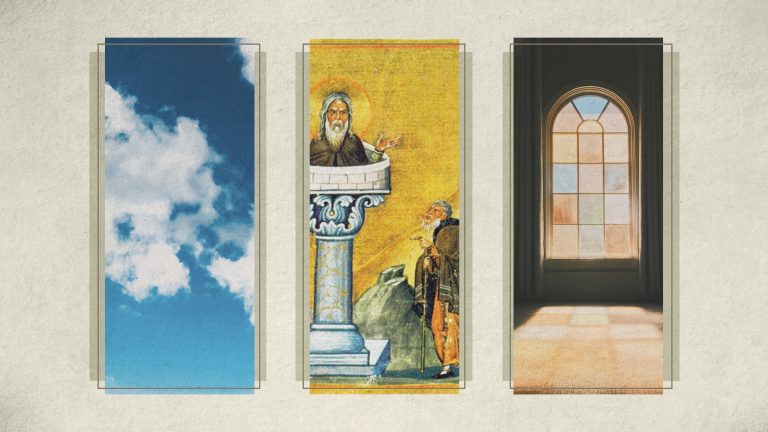
Even in this Lenten season, when many Christians put ashes on their heads, this behavior seems extreme. Isn’t it masochistic? How is anyone served by such a disgusting act of repentance and devotion? Other early Christian ascetics, too, were known for unusual feats. Simeon the Stylite sat atop a pillar for over 30 years. Others ate nothing but grass, confined themselves in tiny cells, lived among animals, or deprived themselves of food and other bodily necessities for extraordinary periods of time. In their own day as well as now, people have rightly questioned the purpose and spiritual value of these bizarre behaviors.

To us, suffering in general seems about as attractive as eating phlegm. We’ll do nearly anything to avoid it. But the monk in the original story has a different mindset: He’s more concerned with avoiding sin than avoiding suffering. Hating sin goes right alongside his willingness to suffer physical discomfort. “If a monk hates two things, he can be free of this world,” writes another monk. “A brother inquired, ‘What are they?’ He said, ‘Bodily comfort and conceit.’”

These quirky early Christians were not making an argument about the causes of suffering. Their point was not that every instance of suffering could be traced to a specific act of sin in the sufferer. Job and the explicit teachings of Jesus (John 9:3) would have ruled that logic out. Instead, they were acknowledging the fact that sin breeds suffering as surely as murder leads to death (Romans 6:23). It hurts the sinner, and its effects ripple outward to impact untold others as well.

Perhaps appropriately, then, the way to healing from sin often leads through suffering, not around it. We follow Christ by taking up our crosses, not by averting our eyes, hands, and hearts from the pain of Golgotha.

The message of the ascetics is simple: Lament your sin, even though it hurts.

For these “new martyrs,” as they were often called, lamenting sin was not just an abstract ideal. It was a concrete command of God that took skill, diligence, and divine assistance to obey. Their starting assumption was that repentance should be the continual pattern of the Christian life, not an unusual aberration. In the words of one hermit, “As the shadow goes everywhere with the body, so we ought to carry penitence and weeping with us everywhere we go.”

Of course, there’s more to the Christian journey than sorrow and tears. But if we want to make progress, we’ll need to keep these with us—at least until this life is over. No one is exempt from repentance. As another hermit put it, “When God struck Egypt there was not a house that did not mourn.” By that he means that sin and its effects are universal. We cannot delude ourselves by thinking that we stand squarely on the side of the victims. We are the Egyptians, every last one of us. The logs in our own eyes should be our first concern. Or in the words of yet another ancient Christian ascetic, “Always look at your own sins, and do not judge another’s.”

Source: Christianity Today

All Content & Images are provided by the acknowledged source