


Heated Debate Over Intersectionality and Critical Race Theory Overshadows Southern Baptist Convention’s Racial Reconciliation Sunday

As the Southern Baptist Convention (SBC) marks its annual Racial Reconciliation Sunday on February 9, the denomination faces continued controversy surrounding critical race theory and intersectionality. The observance, now in its 56th year, highlights SBC efforts to eradicate racism, promote healing and unity, and encourage diversity within congregations. Formerly called Race Relations Sunday, the name was changed in the year 2000.

Arguments against Racial Reconciliation Sunday have resurfaced largely due to “Resolution 9: On Critical Race Theory and Intersectionality,” which passed at last year’s SBC convention. The denomination’s Ethics & Religious Liberty Commission (ERLC), which provides resources for Racial Reconciliation Sunday, is trying to clarify what it calls “misinformation” about the observance.

For this year’s Racial Reconciliation Sunday, the ERLC is providing a bulletin insert with an excerpt of Pastor Jamaal Williams’ article “Intentionally Cultivating Multicultural Churches.” Williams, lead pastor at Sojourn Church Midtown in Louisville, Kentucky, credits Jesus with originating the concept of diversity but admits that pursuing it can be challenging.

“The process is painful for pastors and congregations alike,” he writes. “Not only does it challenge heart-level issues of prejudice, but it challenges lifelong preferences regarding music, expressiveness in services, preaching style and more.” Williams advises congregations to strive for Christian maturity, build bridges, “continuously sow seeds” to expand God’s kingdom, listen to one another, and extend grace and forgiveness.

As non-Hispanic whites are projected to become a minority in America, Williams says, churches must start seeking diversity immediately or risk becoming obsolete “monocultural silos.” By contrast, he writes, when earthly congregations reflect “the portrait of heaven we’re given in Revelation 7:9,” they have the power to “transform the mores of society.”

SBC President J.D. Greear has spoken repeatedly about the sin of racism and the common humanity of all people. In 2018 he wrote: “If we want the SBC to be a homogeneous, conservative, white Anglo-Saxon movement, then cultural hegemony is fine. But if we want to reach the diverse communities throughout the U.S., then we better get ready to change our cultural and leadership structures.”

Intersectionality refers to the different ways that various forms of discrimination or marginalization overlap and interact. Critical race theory is a movement to change—and improve—how society organizes itself around racial categories and oppression.

Critics say those ideologies are injecting theological liberalism into society and the SBC. Intersectionality has been at the center of the denomination’s debate about allowing women pastors. John MacArthur called Resolution 9 a “watershed” moment signaling that the SBC is allowing the culture to interpret the Bible.

In an article titled “Critical Race Theory, Intersectionality, and the Gospel,” Tom Ascol calls the concepts “Marxist” and “incompatible with biblical Christianity.” His proposed amendment to Resolution 9, emphasizing that critical race theory and intersectionality aren’t just tools but dangerous ideologies, was rejected at last year’s SBC convention.

Ascol writes that even if they’re considered analytical tools, these concepts can’t be used neutrally because they “have ideas and principles embedded within them that are, at best, antithetical to the way of Christ.” He objects to viewing religion in terms of power dynamics and oppression, saying that “fails to evaluate people in their primary relationship, which is as creatures made in the image of their Creator.”

Focusing on someone’s victim statuses, Ascol writes, “clouds the fact revealed in the Bible that every person’s fundamental problem is that they have sinned against the holy God who created them.”

Writing at SBCVoices.com, Todd Benkert argues that critical race theory and intersectionality may be both a “dangerous ideology” and a “useful analytical tool.” He urges a balance, saying Christians should move beyond “mere trigger words” and not “reject an idea merely because of its source.”

Source: Church Leaders

All Content & Images are provided by the acknowledged source

Pray for First Baptist Church Bay St. Louis, Mississippi

Location: Bay St. Louis, Mississippi

Pastor: Brett Frazier

Weekly Worship: 9:00 and 10:30 AM, Central

Fast Facts: First Baptist Church Bay St. Louis began in 1896. Over the years, it has been a steady lighthouse in a resort town. Many people who visit the church are snow birds or weekenders. The church is known by locals as “the Baptist church in the Bay” that showed up after Hurricane Katrina hit. With the help of 30,000 plus Southern Baptist Convention friends from all 50 states, the church helped rebuild the city of Bay St. Louis.

The Mississippi gulf coast is growing and expanding rapidly, and 90% of the residents in Bay St. Louis admit to having no church affiliation whatsoever. FBC Bay St. Louis is the only SBC church within the city limits. Please pray for Pastor Frazier and the members as they minister to their community and visitors to their area.

Also pray for FBC Bay St. Louis’ staff as they prepare for their upcoming Easter services.

Website: www.fbcbsl.org


“Pray for . . .” is the Sunday blog series at ThomRainer.com. We encourage you to pray for these churches noted every Sunday. Please feel free to comment that you are praying as well.

If you would like to have your church featured in the “Pray for…” series, fill out this information form..

… Read More

—

Click here to read the rest of the story from our content source/partners – Thom Rainer.

قالب وردپرس

Soldier Kills 26 in Bloodiest Shooting Spree in Thailand

NAKHON RATCHASIMA, Thailand (AP) — A soldier with a grudge gunned down 26 people and wounded 57 in Thailand’s worst shooting spree before he was fatally shot inside a mall in the country’s northeast on Sunday, officials said.

Officials said the soldier was angry over a financial dispute, first killing two people on a military base and then went on a far bloodier rampage Saturday, shooting as he drove to the mall where shoppers fled in terror.

It took police sharpshooters 16 hours to end the crisis.

Authorities said Sgt. Maj. Jakrapanth Thomma was behind the attack in Nakhon Ratchasima, a hub for Thailand’s relatively poorer and rural northeastern region. Much of the shooting took place at Terminal 21 Korat, an airport-themed mall filled with colorful Lego sculptures, a merry-go-round and huge replicas of landmarks from around the world.

“This incident was unprecedented in Thailand,” Prime Minister Prayuth Chan-ocha told reporters as he gave the final tally Sunday morning after visiting the wounded in hospitals.

“I hope this is the only one and the last incident, and that it never happens again. No one wants this to happen. It could be because of this person’s mental health in this particular moment,” he said.

Prayuth said he was worried that people inside the mall could be accidentally hit by bullets fired by police, but added, “I have checked, that didn’t happen.”

Video taken outside the mall showed people diving for cover as shots rang out mid-afternoon Saturday. Many were killed outside the mall, some in cars, others while walking.

Nattaya Nganiem and her family had just finished eating and were driving away when she heard gunfire.

“First I saw a woman run out from the mall hysterically,” said Nattaya, who shot video of the scene on her phone. “Then a motorcycle rider in front of her just ran and left his motorcycle there.”

Hundreds of people were evacuated from the mall in small batches by police while they searched for the gunman.

“We were scared and ran to hide in toilets,” said Sumana Jeerawattanasuk, one of those rescued by police. She said seven or eight people hid in the same room as her.

“I am so glad. I was so scared of getting hurt,” she said.

Shortly before midnight, police announced they had secured the above-ground portion of the mall, but were still searching for the shooter. About 16 hours later, officials held a news conference outside the mall to announce the gunman was fatally shot.

Defense Ministry spokesman Kongcheep told Thai media that the first person killed was the commanding officer of the 22nd Ammunition Battalion, in which the suspect also served. He said the gunman had fired at others at his base and took guns and ammunition before fleeing in an army Humvee.

City and neighborhood police officers, who asked not to be identified because they were not authorized to release information, said the man fired shots as he drove to the mall. Thai Rath television aired mall security camera footage showing a man with what appeared to be an assault rifle.

The man also posted updates to his Facebook page during the rampage.

“No one can escape death,” read one post. Another asked, “Should I give up?” In a later post, he wrote, “I have stopped already.”

A photo circulated on social media that appeared to be taken from the Facebook page shows a man wearing a green camouflaged military helmet while a fireball and black smoke rage behind him. Jakrapanth’s profile picture shows him in a mask and dressed in military-style fatigues and armed with a pistol. The background image is of a handgun and bullets. The Facebook page was made inaccessible after the shooting began.

Terminal 21 Korat, a multi-level glass and steel mall, is designed to resemble an airport terminal, complete with a mock control tower and departure gates. A large model passenger jet dangles from wires beside one of the main escalators.

Each of its seven retail floors is decorated to represent a different country. A giant replica of Paris’ Eiffel Tower soars to the ceiling, while a model of London’s Big Ben dominates another area, and a massive model of California’s Golden Gate Bridge spans an open courtyard. A two-story golden Oscar statue towers over a food court.

Many malls in Thailand, including Terminal 21’s namesake in Bangkok, have metal detectors and security cameras at entrances manned by uniformed but unarmed security guards. Checks on those entering are often cursory at best.

In Bangkok, the original Terminal 21 in the bustling heart of the city was filled with shoppers as usual Sunday morning. There were no signs of increased security or commemoration of the tragedy that unfolded a few hours’ drive away.

Gun violence is not unheard of in Thailand. Firearms can be obtained legally, and many Thais own guns. Mass shootings are rare, though there are occasional gun battles in the far south of the country, where authorities have for years battled a long-running separatist insurgency.

The incident in Korat comes just a month after another high-profile mall shooting, in the central Thai city of Lopburi. In that case, a masked gunman carrying a handgun with a silencer killed three people, including a 2-year-old boy, and wounded four others as he robbed a jewelry store. A suspect, a school director, was arrested less than two weeks later and reportedly confessed, saying he did not mean to shoot anyone.

Copyright 2020. The Associated Press. All rights reserved.

Source CBN

All Content & Images are provided by the acknowledged source

Jason Carter on Why Christians Need to Be Meek During This Year’s Elections

“Blessed are the meek, for they shall inherit the earth.” (Matthew 5:5)

Evangelicalism is a house divided politically in 2020.  The last few weeks have seen major evangelical volleys back and forth over the political divide.

The brouhaha started with Christianity Today’s editor-in-chief Mark Galli’s editorial “Trump Should be Removed from Office” and continued to gain steam with the follow-up piece from CT’s President/CEO Timothy Dalrymple’s “The Flag in the Whirlwind.” The most recent high-level evangelical rebuttal was penned by evangelical theologian and ethicist Wayne Grudem “Trump Should Not be Removed from Office.” All call themselves evangelicals.  All are highly respected. CT has been the flagship evangelical periodical since 1956, being founded by Billy Graham, and Grudem is responsible for Systematic Theology, one of the most popular single-volume systematic theology textbooks assigned in seminaries and bible colleges over the last 25 years. There is probably not an evangelical pastor in America who has not read Christianity Today or heard of Wayne Grudem.

I have no reason to exacerbate the divisiveness.  My voice is not a national voice. My concern is pastoral and local: to shepherd the people under my care and make sure our corporate witness to Jesus Christ in our community is stronger in 2020 despite the divisiveness of our political landscape. To that end, let me make a modest proposal and advocate for a seemingly forgotten Christian attribute.

I believe the Christ-centered trait evangelicals most need in the political arena (and on social media) in 2020 is meekness. Let me explain.

In the 17th century, Matthew Henry wrote a little book called A Discourse on Meekness and Quietness of Spirit. The puritan writer argued that the old term meekness (mansuetus in Latin) was often associated with the process of taming wild beasts of burden and curbing the aggressiveness of a wild, bucking stallion. By curbing a naturally aggressive nature, meekness could actually characterize a formerly aggressive horse.

The opposite of meekness is unbridled aggressiveness rooted in an easily bruised ego that lashes out with the tongue. The opposite of meekness is wading into controversy at every opportunity while provoking the other in endless confrontation.  Matthew Henry argued that meekness wisely cools the heat of passion and curbs the often-untamable tongue. Meekness is strength harnessed.

In short, a meek person gives a wise, poised, and measured reaction – something often foreign to the hyper-aggressive type of engagements that have become (virtually) normalized on social media.

I believe evangelical Christians would be wise to recover the lost trait of meekness during the upcoming political elections. Yes, there is a place for healthy discourse in the public square. Yes, there is a place for healthy dialogue across the political spectrum. Yet the modest question I raise to my fellow evangelicals is this: is social media the place where those ideals organically happen in a manner that adorns the gospel of Jesus Christ above all things in a winsome way to a watching world?

In a previous blog post, I alluded to George C. Edwards III, the presidential historian at Texas A&M, who conducted the seminal study on the history of “The Bully Pulpit” in American politics.  The results were counter-intuitive.  During the 20th and 21st centuries, presidents have given fireside chats, appeared on radio and TV, and crisscrossed the nation to stump at rallies for their point of view.  Edwards’ study argues persuasively that all those activities of “The Bully Pulpit” never moved the needle of public opinion in the President’s favor or translated into significant legislative victories for presidential policies in Congress.

“It is true for all presidents. They virtually never move public opinion in their direction,” Edwards tells National Journal…”It happened for Ronald Reagan. It happened for FDR. It happens all the time. You should anticipate failure if you’re trying to change people’s minds. The data is overwhelming.” [1]

In other words, all the ranting and raving, all the advocating and cajoling by the President of the United States of America – the most influential and powerful person on the planet for much of the 20th and 21st centuries – did not sway public opinion.

Source: Church Leaders

All Content & Images are provided by the acknowledged source

Jon Nielson on 3 Common Traits of Youth Who Don’t Leave the Church

Jon Nielson is the college pastor at College Church in Wheaton, Illinois. Jon is currently working toward his Doctor of Ministry degree at Trinity Evangelical Divinity School. He has authored two books: Bible Study: A Student’s Guide (P&R, 2013) and The Story: The Bible’s Grand Narrative of Redemption (P&R, 2014). The views expressed in this commentary do not necessarily represent those of BCNN1.

“What do we do about our kids?” The group of parents sat together in my office, wiping their eyes. I’m a high school pastor, but for once, they weren’t talking about 16-year-olds drinking and partying. They were talking about youth church attendance. Each had a story to tell about a “good Christian” child, raised in their home and in our church, who had walked away from the faith during the college years. These children had come through our church’s youth program, gone on short-term mission trips and served in several different ministries during their teenage years. Now they didn’t want anything to do with it anymore. And, somehow, these mothers’ ideas for our church to send college students “care packages” during their freshman year to help them feel connected to the church didn’t strike me as a solution with quite enough depth.

The daunting statistics about churchgoing youth keep rolling in. Panic ensues. What are we doing wrong in our churches? In our youth ministries?

It’s hard to sort through the various reports and find the real story. And there is no one easy solution for bringing all of those “lost” kids back into the church, other than continuing to pray for them and speaking the gospel into their lives. However, we can all look at the 20-somethings in our churches who are engaged and involved in ministry. What is it that sets apart the kids who stay in the church? Here are just a few observations I have made about such kids, with a few applications for those of us serving in youth church ministry.

The Apostle Paul, interestingly enough, doesn’t use phrases like “nominal Christian” or “pretty good kid.” The Bible doesn’t seem to mess around with platitudes like: “Yeah, it’s a shame he did that, but he’s got a good heart.” When we listen to the witness of Scripture, particularly on the topic of conversion, we find that there is very little wiggle room. Listen to these words: “Therefore, if anyone is in Christ, he is a new creation. The old has passed away; behold, the new has come” (2 Cor. 5:17). We youth pastors need to get back to understanding salvation as what it really is: a miracle that comes from the glorious power of God through the working of the Holy Spirit.

We need to stop talking about “good kids.” We need to stop being pleased with youth church attendance. We need to start getting on our knees and praying that the Holy Spirit will do miraculous saving work in the hearts of our students as the Word of God speaks to them. In short, we need to get back to a focus on conversion. How many of us are preaching to “unconverted evangelicals”? Youth pastors, we need to preach, teach and talk—all the while praying fervently for the miraculous work of regeneration to occur in the hearts and souls of our students by the power of the Holy Spirit! When that happens—when the “old goes” and the “new comes”—it will not be iffy. We will not be dealing with a group of “nominal Christians.” We will be ready to teach, disciple and equip a generation of future church leaders—“new creations”!—who are hungry to know and speak God’s Word. It is converted students who go on to love Jesus and serve the church.

Recently, we had “man day” with some of the guys in our youth group. We began with an hour of basketball at the local park, moved to an intense game of 16” (“Chicago Style”) softball, and finished the afternoon by gorging ourselves on meaty pizzas and two-liters of soda. I am not against fun (or gross, depending on your opinion of the afternoon I just described) things in youth church ministry. But youth pastors especially need to keep repeating the words of Ephesians 4:11-12 to themselves: “[Christ] gave…the teachers to equip the saints for the work of the ministry, for building up the body of Christ.” Christ gives us—teachers—to the church, not for entertainment, encouragement, examples or even friendship primarily. He gives us to the church to “equip” the saints to do gospel ministry in order that the church of Christ may be built up.

If I have not equipped the students in my ministry to share the gospel, disciple a younger believer and lead a Bible study, then I have not fulfilled my calling to them, no matter how good my sermons have been. We pray for conversion; that is all we can do, for it is entirely a gracious gift of God. But after conversion, it is our Christ-given duty to help fan into flame a faith that serves, leads, teaches and grows. If our students leave high school without Bible-reading habits, Bible-study skills, and strong examples of discipleship and prayer, we have lost them. We have entertained, not equipped, them…and it may indeed be time to panic!

Source: Church Leaders

All Content & Images are provided by the acknowledged source

Charles Stone on the 5 Biggest Mistakes Pastors Make on Sundays (and How to Avoid Them)

Dr. Charles Stone is Lead Pastor at West Park Church in London, Ontario, Canada. He is the author of five books including Holy Noticing: The Bible, Your Brain, and the Mindful Space Between Moments (Moody Press, 2019). His sixth book coming in October by Equip Press, will be Every Pastor’s First 180 Days: How to start and stay strong in a new church job. The views expressed in this commentary do not necessarily represent those of BCNN1.

For pastors, Sunday can be the most draining day of the week. Intense people interaction, teaching or preaching, seeing our critics, trying to remember names, and attempting to put our own problems aside to listen to other peoples’ problems add up to a stress-filled day. The very day we want to be at our best requires more from us than any other day. As a result, we can easily make one or more of the five biggest mistakes pastors make on Sundays. Evaluate this list to find out how many you make. I follow the list with some suggestions on how to avoid them.

All Content & Images are provided by the acknowledged source

Calvinist Blog Sends Southern Baptist President J.D. Greear ‘Worst Christian of 2019’ Award

J.D. Greear, the President of the Southern Baptist Convention since 2018, was voted the worst Christian of the year in 2019. Greear pastors The Summit Church in North Carolina, one of Outreach Magazine’s Fastest Growing Churches in America. As many pastors can probably relate to, not everyone in his congregation is without displeasure about something he may have done, said, or preached on. Many can also relate as well, that with the emergence of social media and everyone offering their criticism online, the walls of influence broaden beyond the walls of the church.

The Pulpit & Pen is known as a Calvinist blog with a history of criticizing the Charismatic movement, liberal Christianity, the Southern Baptist Convention, and many others they disagree with. On January 1, 2020 Pulpit & Pen posted an article entitled ‘Who is the Worst Christian of 2019?’ Its nominees for the title were Danny Akin, Beth Moore, J.D. Greear, Jeff Durbin, James MacDonald, and John David Edie. Writer Seth Dunn called Greear’s leadership deplorable because his church cancelled Sunday services during Christmas, charged for tickets to a Good Friday service, he supported Beth Moore, and he preached about the Bible whispering about homosexuality.

Pastor Greear won the Worst Christian of 2019 award, professionally engraved and topped with a goat on the top. He posted it on Twitter with the hashtag #worstchristian2019 and #thegoat. Over 628 people have commented on the photo, and over 4000 have liked it. The award probably came from someone as a joke because of the Pulpit & Pen article and therefore probably did not come from Pulpit & Pen itself. *Correction, I apologize to Pulpit & Pen writer Seth Dunn as he reached out to me and confirmed he did send the trophy. 

Well, this came in the mail today, anonymously. It was an honor just to be nominated. Never dreamed I’d win. #worstchristian2019 #thegoat pic.twitter.com/0lonmSmQ9J

— J.D. Greear (@jdgreear) February 6, 2020

Priscilla Shirer, Beth Moore, Daniel Im, Jen Wilkin, D.A. Horton, Rebecca McLaughlin, and hundreds of others have commented on the award.

Source: Church Leaders

All Content & Images are provided by the acknowledged source
Dale Hudson on Seeing Ministry as a Calling of God or a Career

Dale Hudson has been serving in children’s ministry for over 30 years. He is an author, speaker and ministry leader.  He is the founder and director of Building Children’s Ministry. BCM helps churches build strong leaders, teams and children’s ministries. The views expressed in this commentary do not necessarily represent those of BCNN1.

I recently heard someone talking about their “career” in children’s ministry. I personally don’t believe ministry is a career.  I believe it is a calling of God.

Most people who are in ministry are not in it because they decided to make a “career” of it.  They are in ministry because God did a supernatural work in their heart and ushered in an invitation to give their life to reaching and discipling people.

That was my case.  When I was 16-years-old, God began to quietly whisper into my spirit that He wanted me to give my life to reaching people.  At first, I said “no way.”  That is not something that was on my radar.  And it was definitely not something I wanted to pursue.  But the “calling” continued to pursue me.

I’ll never forget the day I got on my knees and said “yes” to God’s call.  I told God I’m going to stop running away from Your plan for my life and start running toward it.

And if you are called, I am sure you remember God pursuing you for ministry as well.

Even now, you may sense God calling you to give your life to reaching kids and families.  You may be experiencing a burning bush call from God.

A career is about the income.  A calling of God is about the outcome.

A career is you pursuing finances and prestige.  A calling is you pursuing God.

A career comes from your plans.  A calling comes from God’s plans.

A career is about climbing the ladder.  A calling is about climbing higher in your relationship with God.

A career is about seeing how many people can serve you.  A calling is about seeing how many people you can serve.

Source: Church Leaders

All Content & Images are provided by the acknowledged source

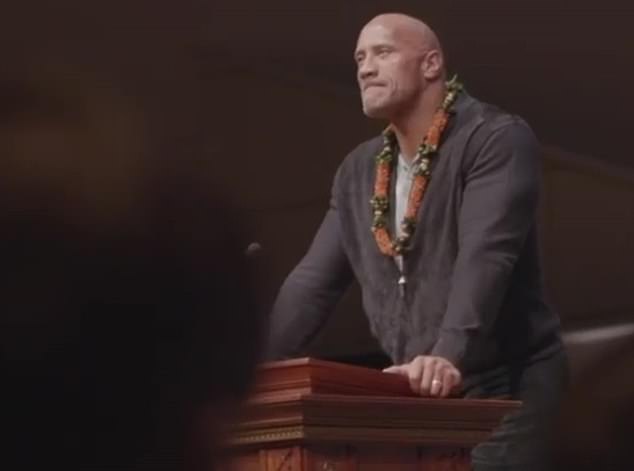
Dwayne ‘the Rock’ Johnson Pays Tribute to Late Wrestler Father Rocky ‘Soul Man’ Johnson With Tearful Eulogy

Dwayne ‘The Rock’ Johnson has been mourning the loss of his father Rocky ‘Soul Man’ Johnson.

Also a professional wrestling legend, his friends and family held a funeral for him last month.

The Rock took to Instagram Saturday with a video of the tearful, heartfelt eulogy he gave at the wake.

He also accompanied the video with a beautiful caption: ‘Dad, you lived a full and meaningful life.

‘You trail blazed and even harder, you changed people’s harsh behaviors toward a man of color. Paving the way for me, my family and generations to come.’

The caption concluded: ‘I love you and now I have an angel to call by name. I’ll see you down the road, Soulman. Til we meet again. Your son.’

The 47-year-old took a few seconds to start his speech, as he attempted to work up the words while choking back tears.

Source: Daily Mail

All Content & Images are provided by the acknowledged source

CrossFit Spokesperson Who Was Fired for Biblical Beliefs on Homosexuality Asks for Funds for Wife’s Life-Saving Transplant

In 2018, popular exercise and fitness company CrossFit found itself in the crosshairs of the LGBT outrage mob. Russel Berger, a legal researcher and spokesperson for CrossFit, was eventually fired after tweeting in defense of a franchise owner who canceled an LGBT pride-themed related workout because he believed pride is a “foundational detractor of health.”

After standing up for his belief in God and being punished for it, a showing of faith that was greatly edifying and encouraging to millions of believers who read the story, Berger is now humbly seeking help as his wife’s medical condition is deteriorating and medical bills are mounting.

After writing on Facebook that help is “not easy for me” to ask for because he is “prideful and stubborn,” Berger opened up about how difficult it has become to be a full-time caretaker while also trying to provide for his family.

The GoFundMe has already raised $50,000 out of the $100,000 goal — but even that is only scratching the surface of what he needs.

Want to help? You can do so HERE.

Berger explained his situation:

For the past ten years, I (Russell) have watched my wife Katherine battle a rare genetic disorder. It has affected her connective tissues, her autonomic nervous system, and multiple organ systems in her body.

Despite her doctor’s best efforts, Katherine’s condition has deteriorated. Last year, she was diagnosed with intestinal failure. Since September of last year, her only source of nutrition and fluid has been through a central line to her heart. She has also continued to receive bimonthly infusions of immunoglobulin that help to keep her disease from progressing further. Katherine is currently being treated by some of the best gastrointestinal  doctors in the world, and has been recommended for intestinal transplant.

Though we are thankful for these life-saving interventions, they present a constant risk of complications. She has had multiple hospitalizations over the past few months, and had three central lines replaced due to infection.

As Katherine’s illness has progressed, she has lost the ability to drive, and struggles to complete many simple daily tasks on her own. Our 11-year old has also begun to show symptoms of the same disease, and has lost the ability to walk. Out of necessity, I have become a full-time caretaker for our family. This has been very difficult for us financially.

Source: CBN

All Content & Images are provided by the acknowledged source