


Impeachment Leads to Theological War of Words Between Trump, His Critics, and His Supporters

Religious rhetoric is not uncommon on Capitol Hill, where politicians often thread references to the Almighty into speeches while participating in political theater. But in the drama-filled final week of President Trump’s impeachment trial, God was essentially a supporting character.

Senator Lindsey Graham said he used his God-given common sense to decide the impeachment case against President Trump was “BS.”

Senator Mitt Romney declared his faith compelled him to believe the president was guilty of an impeachable crime.

The President himself insisted that faith was a crutch used by his rivals — and admitted that following Jesus’s advice about “loving your enemies” was hard for him.

All three were part of a theological war of words over Trump’s impeachment that has been going on for months, with the commander-in-chief and his opponents invoking the divine and questioning each other’s faith.

Lawmakers from both parties — including Rep. Alexandria Ocasio-Cortez, D-New York, and Rep. Barry Loudermilk, R-Georgia — quoted scripture in December to shore up their respective arguments regarding the impeachability of the president’s actions. The faith debate heated up days later when the editor of Christianity Today garnered a rebuke from the president for penning a bombshell editorial calling for Trump’s removal from office.

But the God talk escalated in earnest on Wednesday (Feb 5.), when Utah Sen. Mitt Romney, a member of the Church of Jesus Christ of Latter-day Saints, cited his faith while explaining his decision to break with his party and vote to convict Trump of at least one offense.

“I am profoundly religious,” he said in explaining the decision. “My faith is at the heart of who I am.”

Romney’s remark and eventual vote triggered a heated reaction from Donald Trump when the president delivered a speech on Thursday at the National Prayer Breakfast, an annual religious gathering in Washington, D.C.

“I don’t like people who use faith for justification for doing what they know is wrong,” Trump said in a reference to Romney.

The president would voice a similar critique a few hours later during an address at the White House. After celebrating his acquittal, he railed against lawmakers who supported his impeachment and removal from office, singling out Romney in particular.

“And then you have some that used religion as a crutch,” he said, noting that he was referring to a “failed presidential candidate” and suggesting that Romney had “never used” faith in political discourse in the past.

Romney has spoken about his faith often as a politician, and once delivered an entire speech on his religious beliefs while running for president in 2007. His office declined to comment on the president’s remarks.

Trump received backup on Thursday from South Carolina Sen. Lindsey Graham, who was asked about Romney during an appearance on “The Brian Kilmeade Show.”

“All I can tell you is that God gave us free will and common sense. I used the common sense God gave me to understand this was a bunch of BS,” Graham said. “They hate Trump, they were going to impeach him the day he got elected and if you can’t see through this, your religion is clouding your thinking here.”

He also doubted Trump’s impeachment would play a role in his pursuit of eternal salvation.

“When I go to meet God at the pearly gates, I don’t think he’s going to ask me, ‘Why didn’t you convict Trump?’ I may be wrong, but I don’t think that’s going to be at the top of the list,” Graham said.

Source: Religion News Service

All Content & Images are provided by the acknowledged source
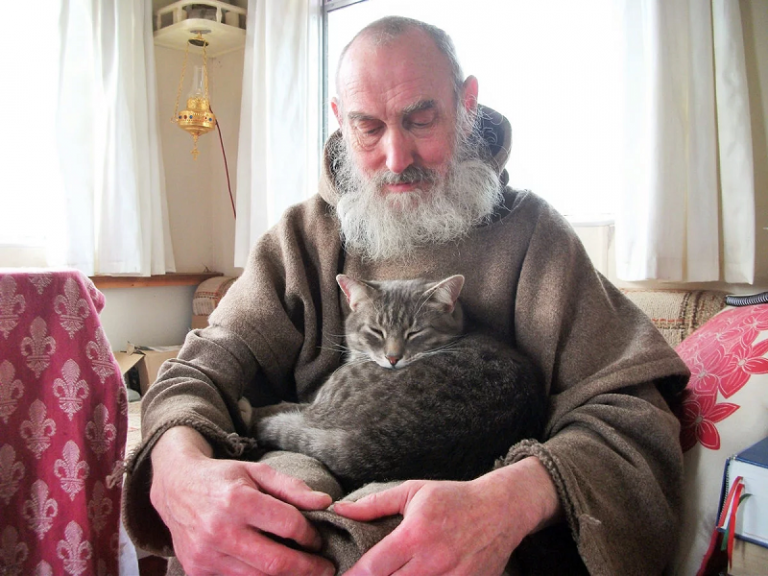
Excommunicated Catholic Hermit Monks Find Peace in Scotland

Stephen De Kerdrel, a hermit monk who was recently excommunicated by the Catholic Church, didn’t like Pope Francis right off the bat.

While watching the pontiff on TV as he emerged for the first time in 2013 before faithful gathered in St. Peter’s Square, De Kerdrel took a good look at the pope’s clothes — simple and unadorned — and knew, he said, that something was “terribly, terribly wrong.”

Francis’ decision not to wear the mozzetta, the red velvet and fur lined cape reserved for popes, was for De Kerdrel the initial indication that this pontificate was going to break with tradition. As the Argentine pope’s pontificate progressed, it became clear to De Kerdrel that the Catholic Church was opening its doors to the world in an unprecedented way.

But from the remote Orkney island of Westray in the far north of Scotland where he lives, De Kerdrel and his two companions — fellow monk Damon Kelly and Sister Colette Roberts — were not seeking to build bridges with the world.

Instead, the trio was trying to escape from it.

Day after day, that world evolved further away from their beliefs, casting the three out to places that (despite their isolation), in today’s interconnected reality filtered through sectarian news outlets, were never remote enough.

Just before Christmas, the three hermits were excommunicated by the Roman Catholic Church for denouncing Pope Francis and most of the Roman Catholic Church’s hierarchy as being in league with Satan.

“We have broken from a false pope, a false magisterium, at the moment, and a false Curia and false bishops and cardinals,” De Kerdrel told Religion News Service in a mid-January phone interview.

“We’ve broken with them; we’ve not broken with the church. The church is there, but it’s under all this mess,” he said.

A variety of cats live with the monks on the island of Westray in Scotland. Courtesy photo

Excommunication is the latest step in a long journey by the three companions who, for years, have tried to cut themselves off from the sins of the world, as they see it, so they can live closer to God.

It’s a journey that took them from the Midlands of England to the remote islands of Scotland. They have been living there as hermits since 2016, with a handful of cats, in a pair of run-down homes with no running water. They have just enough electricity from solar power to run their blog and help them manage during the half of the year when sunlight is scarce.

The journey began 21 years ago this April, when both Kelly, now 58, and De Kerdrel, now 67, left the Capuchins, a Catholic religious order, to become hermits. While it’s hard to believe today that some still choose a hermetic lifestyle, the practice continues to exist in the Catholic tradition, as well as in many other religions.

Traditionally desert-dwellers who trace their origins to the prophet Elijah, Christian hermits choose to seclude themselves from the comforts and distractions of interacting with fellow humans to devote their lives to prayer, and sometimes penance, in order to support the world with their intentions.

Throughout history, hermits have enriched the Catholic tradition with some of its holiest and most intellectual minds, including St. Jerome and St. Basil, whose contributions to Catholic thinking and theology have led them to be considered “doctors of the church.”

Though beards, fasting and vows of silence are still a mark of hermits today, not everyone leading a hermetic life is isolated from the world. Mario Aguilar, a Benedictine hermit originally from Chile who also lives in Scotland, is a professor of divinity at the University of St. Andrews and is an active Twitter user.

“You have to look at the complexity of the different kinds of contemplative lives,” he told RNS in a phone interview (Feb. 7), adding that there are as many types of hermits as there are priests and lay people. Today, he added, a growing number of lay people have been attracted to this lifestyle, including himself.

“In secular terms, the hermit is somebody spending more time in solitude rather than in a community for the purpose of finding God,” he said.

Aguilar’s book, “The Way of the Hermit,” details his life as an eremite and activist, sleeping on the floor, providing his own food, occasionally listening to the BBC or praying for the victims of the coronavirus. He invites Buddhist and Hindu hermits to retreats and wrote a biography of Pope Francis, whose work he follows with passion.

“The eremitic vocation is to see God, but not in a selfish manner,” he said, adding that “you have to be a terrible hermit to start worrying and start blogging.”

But the three hermits in Orkney, according to Aguilar, may have been disenchanted with the world already, choosing to initiate a “Catholic revival” not unlike the Celtic monks who arrived on the island as early as the 4th century.

“It has been an odyssey like no other,” De Kerdrel said.

For years, the hermits moved from one island to another, never being able to find a place where they were welcome or didn’t get into trouble.

At first, the hermits were set up in a hut in the Galloway Hills in Scotland with a small wooden chapel and a garden. They were then separated, with De Kerdrel going to the jagged coasts of the Isle of Mull and Kelly to administer to youth not too far away.

Once reunited, Kelly and De Kerdrel were joined by Roberts, now 64, in 2004 after she left behind her job as a consultant surgeon in the U.K. Before that she had been taking care of her chronically ill mother, who died in 2002.

De Kerdrel described her as “an anchorite nun,” referring to the women who would traditionally live in small homes attached to the church and care for its needs.

The hermits’ real troubles began after the July 2013 passage of a bill by the British Parliament legalizing same-sex marriages, which are considered “intrinsically disordered” unions by the Roman Catholic Church. That decision prompted Kelly to aggressively protest against homosexuality — including passing out leaflets that police have described as “homophobic” and telling a lesbian couple that the Catholic Church “used to burn people like you,” according to news reports.

Eventually Kelly was arrested 13 times, convicted five times and spent about 148 hours in prison cells, said De Kerdrel. Kelly’s public distaste and aggressiveness toward same-sex couples led the bishop of the Diocese of Northampton, in England, to ask the hermits to leave.

Source: Religion News Service

All Content & Images are provided by the acknowledged source

BET’s “Sunday Best” to Return for 10th Season Spring 2020

BET’s Sunday Best is returning for season 10.

Jonathan McReynolds took to Instagram to make the announcement, also sharing that he’d be sitting in the middle of the judges panel again.

If you think you have what it takes to be gospel’s next superstar, submit your audition here.

Good news. Better news. Great news. Greater news. 🙌🏾 @betsundaybest #BetSundayBest

A post shared by Jonathan McReynolds (@jonmcreynolds) on

SOURCE: Gospel Goodies – Aliya Faust

All Content & Images are provided by the acknowledged source

China’s Coronavirus Reminiscent of Third Century Plague that Ravaged the Roman Empire

As the coronavirus  spreads, Christians remember a plague that ravaged the Roman Empire in the third century.

The coronavirus continues to spread in China and other Asian countries – there are over 20,000 cases worldwide. It is a time of fear for many people, but Denise Godwin of International Media Ministries (IMM) finds a parallel between the coronavirus and a plague that ravished Rome and the surrounding lands roughly AD 250-270.

She says IMM was shooting the story of Cyrprian, a bishop of Carthage. The plague was actually named after him because he rallied the Christians to care for the sick and even attend to burial for the dead. “But the thing that struck me the most [is] now as we see this modern day plague creeping into our newsfeed . . these Christians in the third and the fourth century, went and helped people who [were] being shut out in the streets by family members who were panicked because of the illness that they were seeing.”

Cyprian himself remarked the plague was so severe it seemed like the world was ending. The plague, combined with near-constant wars, left the Roman Empire depleted, and famines followed. While the exact nature of the disease is unknown, some experts point out similarities to Ebola.

Godwin says, “I’m inspired by the believers in the third and fourth centuries who made a mark on their community by serving people who were harmed by the plague of their times.”

SOURCE: Mission Network News, Kevin Zeller

All Content & Images are provided by the acknowledged source

InterVarsity Christian Fellowship Reaching Native Students with the Gospel

A U.S. campus ministry is reaching the hearts of Native American young people.

InterVarsity Christian Fellowship began its Native-specific ministry in 2000. Today, the program is changing lives, perceptions, and even worship styles.

Megan Murdock Krischke joined InterVarsity as a student, then went on to join the staff after graduation. Krischke is the daughter of a Cherokee mother and a Wyandotte father, so it didn’t take long for her to notice there was nothing for Native students among InterVarsity’s multi-ethnic ministries.

“I knew I was Native and just cared about everyone having a place at the table,” Murdock Krischke says.

“My dream for my life… is that by the time I die, Native communities would find it laughable that they ever considered Jesus the ‘white man’s God’. Because the reality is, He’s… an ethnic man, a tribal man.”

In 2016, Murdock Krischke became InterVarsity’s first-ever national Native Ministries Coordinator. She identifies five thresholds each Native person must cross in their journey of faith.

The first step is the hardest one: beginning to trust Christians. Given historic relations between Christians and Native communities, this can be a long and difficult process.

“The Church has mistreated Native people and communicated that they’re not made in the image of God… that’s just a big threshold [to cross],” Murdock Krishke says.

Several years ago, Murdock Krishke and her husband began a Native-specific chapter at Fort Lewis College in Colorado.  Describing her experience gaining the community’s trust, Murdock Krishke says, “When we first came to Fort Lewis, they wouldn’t even let us hang a poster in the Native Student Center. But, in year seven, we had a key.”

Cultivating curiosity is a little easier, Murdock Krischke says. When believers express their faith through Native culture, it sparks curiosity.

“They have had the Church telling them ‘You can’t do that’, and they’ve had traditionalists saying ‘You can’t do that’,” she says of incorporating faith and Native culture.

InterVarsity’s Native ministry incorporates Native drums in worship and frybread in communion, giving a familiar feel to things that were formerly foreign.

SOURCE: Mission Network News, Kali Katerberg

All Content & Images are provided by the acknowledged source

Keys for Kids Sends Hope and Encouragement to Puerto Ricans Shaken by Earthquake

A 5.0 magnitude earthquake shook Puerto Rico yesterday. The U.S. territory is caught in a series of tremblors that began late December and peaked on January 7 with a 6.8-magnitude earthquake.

Fear keeps more than 4,000 people on the streets in tent cities as aftershocks continue. Executive Director Greg Yoder says Keys for Kids Ministries is sending hope and encouragement to Puerto Rican families.

Here’s how you can help – Keys for Kids needs to produce more Spanish Storytellers. By giving online, you can underwrite the cost of this production. Plus, a generous matching gift doubles every donation until the $12,000 goal is met.

As explained here, the Caribbean is prone to seismic activity. Thanks to a wide variety of aid groups, Puerto Rican quake survivors are receiving help. “The survival needs are already being met. Other people have been responding with that… and that is a good thing,” Yoder says.

Believers at “The Rock” Christian radio station in Puerto Rico help meet the physical needs of earthquake survivors. “But, the one thing they lacked was [tools to] reach out spiritually to kids that are struggling,” Yoder explains.

“Anytime you rock a child’s world, they just want something to comfort them.”

SOURCE: Mission Network News, Katey Hearth

All Content & Images are provided by the acknowledged source

From Pitt to ’1917,′ what to anticipate at Sunday’s Oscars

 The Oscars are here, already.

After the shortest awards season in decades, the 92nd annual Academy Awards will get underway Sunday evening at the Dolby Theatre in Los Angeles. The red carpet is being rolled out two to three weeks earlier than usual in a bid to freshen up a ceremony and potentially boost ratings.

The truncated time table has put the normally bloated Oscars season on a diet (Sunday’s show will also for the second straight year be hostless) and sent film academy members scrambling to finish their movie-watching — no small task in a year featuring a few three-hour epics like “The Irishman” and “Once Upon a Time … in Hollywood.”

Fittingly for a fast race, a movie about a mad dash has risen to the top of the heap. After winning nearly every major precursor award, Sam Mendes’ “1917,” about a pair of British soldiers sent with an urgent message to deliver through recently-held enemy territory, is the favorite for best picture. Thanks to its technical dazzle, the seemingly one-continuous-shot “1917” is also likely to come away with the most awards Sunday, even without any acting nominations.

Although Joaquin Phoenix, Renée Zellweger, Brad Pitt and Laura Dern all appear to be all-but-certain locks in the acting categories, there’s still the potential for a history-making upset. Momentum has swung behind Bong Joon Ho’s South Korean thriller “Parasite,” and some believe it has a chance to become the first non-English language film to win best picture.

Such a win would be a watershed moment for the Academy Awards, which has long been content to relegate international films to their own category. But in an effort to diversify its largely white and male membership, the Academy of Motion Pictures Arts and Sciences has inducted more overseas members in recent years. And just about no one has a bad word to say about t he widely-praised class satire “Parasite,” the Palme d’Or winner at last year’s Cannes Film Festival and the first foreign language film to win top honors from the Screen Actors Guild Awards.

The official pre-show will begin at 6:30 p.m. EST on ABC. Among the presenters the academy will lean on in the absence of a host are: Tom Hanks, Maya Rudolph, Spike Lee, Julia Louis-Dreyfus, Chris Rock, Timothee Chalamet, Will Ferrell, Diane Keaton and Kelly Marie Tran.

The ceremony will come just days after the death of Kirk Douglas, one of the last surviving stars of Hollywood’s golden age. Kobe Bryant, a 2018 Oscar winner for the short “Dear Basketball,” is expected to be included in the ceremony’s In Memorium segment.

ABC and the academy will be hoping a widely watched field of nominees — including the $1 billion-grossing “Joker,” up for a leading 11 awards — will help viewership. Last year’s show garnered 29.6 million viewers, a 12% uptick.

This year’s Oscars comes amid a streaming overhaul throughout Hollywood. Hurrying to catch up to Netflix and Amazon, most of the major studios are prepping or have already launched their own streaming services, as have new entrants like Apple. Netflix comes into the Oscars with a leading 24 nominations thanks to “The Irishman,” “Marriage Story,” “The Two Popes” and the likely best documentary winner, “American Factory.”

But despite spending heavily through awards season, Netflix may go home with only a few awards. The streamer is still seeking its first best picture win after Alfonso Cuaron’s “Roma” came up just shy last year.

Instead, this year’s Oscar favorites are largely movies released widely in theaters. They also predominantly feature male characters and come from male directors.

After a year in which women made significant gains behind the camera, no female directors were nominated for best director. The acting categories are also the least diverse since the fallout of #OscarsSoWhite pushed the academy to remake its membership. Cynthia Erivo (“Harriet”) is the only actor of color nominated. Those results, which have been a topic in speeches through awards season, stand in contrast to research that suggests the most popular movies star more people of color than ever before.

Ticket sales slumped about 4% last year despite the Walt Disney Co.’s record $13 billion in worldwide box office. Disney, which acquired 20th Century Fox last spring, accounted for an overwhelming 38% of domestic ticket sales. And yet Disney, aside from owning the network the Oscars are broadcast on, will likely play a minor role at the Academy Awards. The studio may win best animated feature with “Toy Story 4” and possibly best editing for the Fox film “Ford v Ferrari.”

And while Democratic candidates are vying for the presidency and votes are still being counted in Iowa, Barack Obama may well notch another win. The first film from his and Michelle Obama’s production company, “American Factory,” is favored to win best documentary.

___

Source: Associated Press  – JAKE COYLE

All Content & Images are provided by the acknowledged source

Rohingya Christians Dealing with Aftermath of Abduction Attack on Bangladesh Refugee Camp

Rohingya Christians have been moved to safety following an attack in a Bangladesh refugee camp.

Greg Musselman of Voice of the Martyrs Canada (VOMC) explains, “Recently there was an attack and a pastor and his daughter were kidnapped, they were abducted. And then we had received word from kidnappers to our partners, that there is a plan now to forcibly take the pastor’s daughter and marry her to a Muslim man. . . This was going to happen soon.”

The attack, which occurred in the Kutapalong, the world’s largest refugee camp, left 12 Christians wounded. The Christians were refugees from Myanmar who came to Bangladesh in 2007. They claim they were also attacked in May of last year by the same group: Arakan Rohingya Salvation Army (ARSA). According to its Twitter account, ARSA is, “Fighting for the liberation of persecuted Rohingya.”

Local police acknowledge the violence, but maintain that Christians in the camp initiated it by beating and dragging out a man, and that Muslims retaliated. They also deny that ARSA was involved and claim only four Christians were injured.

The attack reportedly left many Christians without homes, as the attackers went into houses and used machetes to destroy them. Police confirmed damage to homes. Following the attack, the Christian families, along with many Hindu families, were isolated from the Muslims by the United Nations.

The attacks also connect to a recent statement by UN Special Rapperteur Yanghee Lee, who voiced concern over the state of religious minorities in the camp.

SOURCE: Mission Network News, Kevin Zeller

All Content & Images are provided by the acknowledged source

More Refugees in Lebanon are Returning to Syria

Continued financial woes in Lebanon leave Syrian refugees without many options except returning to a country still reeling from war. Yet Triumphant Mercy Ministries says that for many refugees, heading home is sounding better and better.

The economic and currency crisis in Lebanon means that compared to the dollar, the lira is coming in short. The exchange rate is close to 1500 lira for one dollar, but on the black market, the exchange rate is almost 2000 to one.

For Lebanese and Syrian workers alike, this poses problems. People don’t want the lira, and there aren’t enough dollars to go around.

Nuna with Triumphant Mercy says, “But the economical crisis is now taking a toll on all refugees because they can’t get jobs like before. Even Lebanese can’t get jobs now. The financial crisis is so bad, that Lebanese are being laid off work and cannot find ways to sustain their own families.”

Without enough money to buy necessities, for many refugees, returning to Syria is starting to sound like a good option.

The problem with going back is that many people came into Lebanon illegally the first time. For them, there is added fear if they cross the border legally.

Nuna says, “They’re afraid that at the border they will be caught, or they will be taken to prison because they are deserters. So they’re thinking about, ‘When is a good time for us to go back over the mountain and go back to their own villages?’ So there’s a lot of talk, much more than before [about returning].”

Yet even if a family or person makes it back into their home town undetected by the government, there is still the issue of physical and financial security.

“There are parts that are not so secure, but there are parts that are becoming more secure. Now the problem is also financial in Syria because of the dollar devaluation of the money, the Syrian pound. The same like Lebanon, the devaluation of the money is the same in Lebanon, and it’s also affecting Syria a lot.”

However, even with those drawbacks and the lack of public infrastructure like schools and hospitals, refugees are thinking of returning.

With the continued issues in Lebanon, their situation is not much better. In fact, in some places public opinion is turning against refugees, blaming them for the economic crisis. They fear crowds retaliating against them.

Whichever side they approach the issue from, refugees face similar issues.

SOURCE: Mission Network News, Anna Deckert

All Content & Images are provided by the acknowledged source

Carol Round on What Scripture Can Do for Your Well-Being

“God has breathed life into all Scripture. It is useful for teaching us what is true. It is useful for correcting our mistakes. It is useful for making our lives whole again. It is useful for training us to do what is right. By using Scripture, the servant of God can be completely prepared to do every good thing”— 2 Timothy 3:16-17 (NIRV).

A commercial many of us are tired of hearing on TV is for a miracle facial product. It’s guaranteed to erase wrinkles and shrink under-eye bags right before your eyes. The product claims to work within 10 minutes to give you a more youthful look. But there’s a catch. It’s only temporary.

One user of the product is a personal trainer in great shape. Feeling her eyes make her look older than she feels, she tried the cream. Now she says her face matches her toned physique, making her look younger than her 61 years.

There’s nothing wrong with taking care of our bodies by eating healthy and exercising. But, as we age, so do our bodies. Wrinkles, under-eye bags, dark spots, and a host of other skin problems can draw us to miracle creams and lotions promising quick fixes to stave off the inevitable.

We won’t live forever—at least in our physical bodies—but there is something we should be focusing on as we draw closer to our eternal home. Reading and studying scripture is better for our well-being than focusing on our external being. Of course, this is a good idea at any age.

Looking in the mirror and lamenting over our aging reflection does nothing for our spiritual wellness. Nor does the fear of what our future holds.

Scripture, unlike anti-aging products, “is useful for teaching us what is true, useful for correcting our mistakes and for making our lives whole again.”  It’s also permanent and doesn’t cost a penny, just time spent in God’s Word.

As we celebrate each birthday, many of us tend to reflect on our past. The could-have, should-have, and would-have thoughts can lead to pessimistic thinking. It’s not healthy.

Hebrews 4:12 says, “For the word of God is living, and active, and sharper than any two-edged sword, and piercing even to the dividing of soul and spirit, of both joints and marrow, and quick to discern the thoughts and intents of the heart” (ASV).

Spending time each morning in the Bible is a spiritual habit I embraced almost 20 years ago. Whether I’m going through a rough patch in my life, wake up in a bad mood, or worried about the future, reading Scripture leads to peace of mind. I gain new strength not found anywhere else.

SOURCE: Assist News

All Content & Images are provided by the acknowledged source
